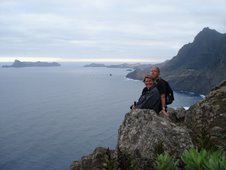
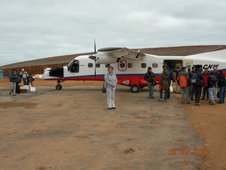
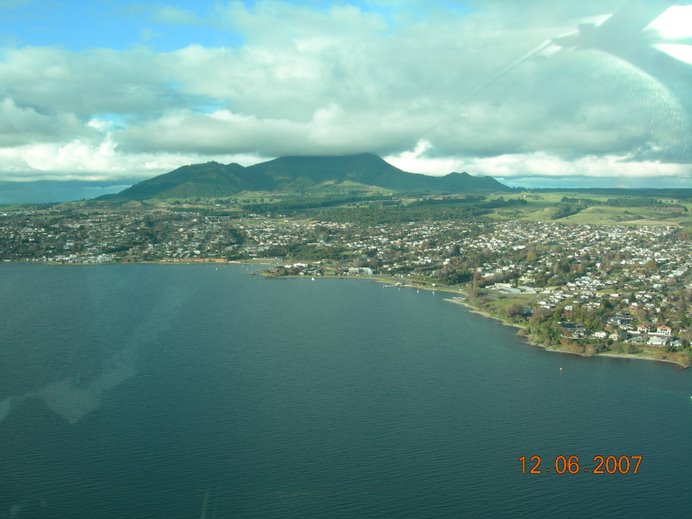
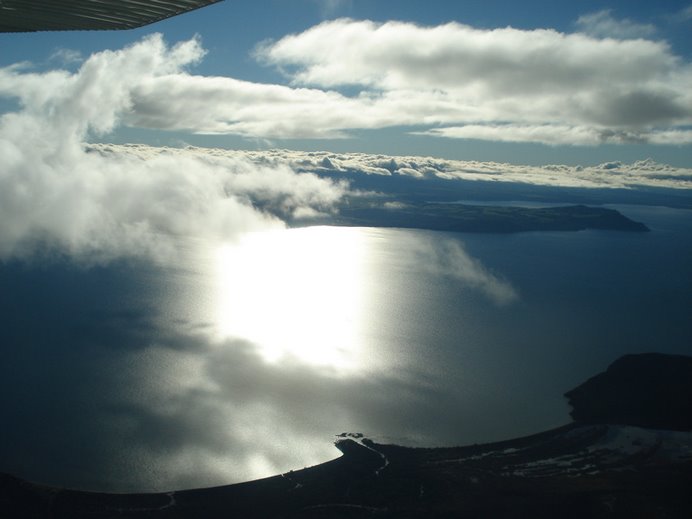
The way to Heron Island is a well trodden path and there is always a great feeling of anticipation on the way there. Once you arrive in Brisbane you check in for the flight to Gladstone which has its own little sub terminal for planes with propellors which always seems like stepping back in time. The plane goes to Gladstone and then you are into the hotels radar and its all things 'Heron'. Gladstone is another town growing at an exponential rate due to it sitting on ludicrously large deposits of 'turkey wrap' or aluminium and coal. There is a huge port and a thousand ships waiting to get in a load Al or Fe into their bowels for dumping in China or Malaysia for 'their' building boom.
Heron Island is approached in one of two ways. By boat, a new 20 million super-cat or by helicopter. the helicopter is a great thrill and the pilot invariably dips down into the reefs that are all part of the same southern portion of the Great Barrier reef system. This is the southern most part of the 2000 km long reef and the largest living organism in the world..in our continual drive towards the biggest, the longest or the most enormous. It isn't of course one organism but it is a living continuous mass which does defy adjectives large enough to describe it! Anyway its awesome...
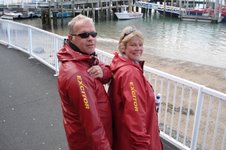
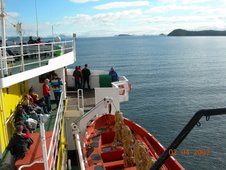
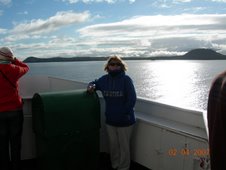
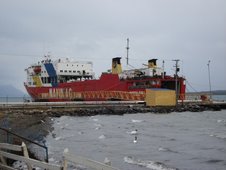
We take the boat and the trip takes two hours. The approach to the islands harbour is unmistakable. The plethora of blues, changing water depths, and the backdrop of yellow and green in an otherwise blue expanse is almost etherial. We are here..Heron Island and fve days of the best diving in the world, coupled with a tropical island of indescribable qualities...oh yes we like it!
Normally at christmas if you come there is a wildlife festival 24 hours a day. If the 'ruddy' noody turns aren't dive bombing you, the herons are causing havoc in the noddy's trees trying to steal their eggs and the 'mutton' birds caw like deserted babies all night in their nocturnal mating 'chat'. Meanwhile the turtles are coming onto the beach every night to lay their eggs which sometimes requires the use of the 'Turtle hotline' present in each of the rooms. If a turtle is in distress or is stuck in a tree root which often happens, one tap of the hotline and the 'turtle rescue team' are despatched to tackle any turtle tribulation!
There is also a research station run by the University of Brisbane which recently burnt down and is being rebuilt.
The diving lives up to expectations although the water temperature is lower than normal and the sun a little lower in the sky. Luckily Fo can snorkel at the same time as the divers are downunder...in fact in some cases the snorkellers see a lot more than the dive team...or so they say.
Brad is the buddy for the week. He is a farmer from north of Melbourne and has dived all over including a stint at the Coral Cay setup in the Phillipines. Only the second person i have met who has been on a Coral Cay expedition.
See www.coralcay.org
So in between diving, snorkelling, swimming with baby sharks in the evening and spending a bit of time with Brad, Sue and Will we just lay on the golden sands of the island and revelled in the solitude and silence. At night the stars reached right down to the horizon,they were as clear as i have seen and we were lucky enough to have a star expert on the island for a bit of education to boot.
Heron Island has to be top ten in the places you have to visit before you move to
Eastbourne.
Lets go to Brissie!!
Friday, 31 August 2007
Saturday, 18 August 2007
Darwin, Cairns and Cape Tribulation
You pull out a tent peg and suddenly rendered frozen in a position no sensible human would choose bent staring at the floor cursing for England. We knew it was bound to happen to one of us slaves to our vertebrae discs – over six weeks camping full of tent erections and blow up mattresses, climbing in and out of cramped vans, on and off precarious bed-ledges designed for lithesome ten year olds. This time the twisted spirit of slippery discs frowned upon Marco – and we gingerly said farewell to Broome in baking sunshine leaving by plane instead of the 4WD drive tour of the Kimbereley’s to Darwin that would have taken us deeply off road 'outback' for sure.
Our short and sultry experience of Darwin was made all the more invigorating by the energetic company of Brad and Aileeen who seemingly took us under their wings as we bumbled around the Barramundi Lodge backpackers like fish out of water searching in vain for pain relief and our ensuite respectively! At 11pm it was a humid 28 degrees and sweat was collecting in pools at our feet. The temperature rockets up in the summer and the humidity clocks 100 per cent. Then only english-folk and backpackers venture out for some extra tea of a long run at midday in a freshly starched collar!!
Our new pals from the Northern territories (of the UK) took us for tours round the compact city which boasts all the trappings of a modern city, a posh harbour full of grog palaces, a waterfront, hotels full of japanese tourists and a higher than average use of valium and amphetamines! Darwin is a town full of outbacker spirit and a real frontier state...the closest town where you can get dinner being Kupang in West Timor. It has gone through sweeping changes over 20 years and boasts all the mod cons and an extraordinary council building which wouldn't be out of place in Gormenghast. Definitely worth a visit and of course right on the start/end of a visit to the Kimberleys
Unfortunately the stifling frustration of not being able to move, sit, stand or lie down comfortably drove Mark onwards and eastwards and we flew out of Darwin three days later to the more temperate climate of Cairns - in search of physiotherapy and the tropical rainforest.
We arrive in Carins and set up in the Comfort Inn. Charming people and comfy beds. Also a small bar by the pool which opened every night for Seabreezes and the 'Lobeter Pot' restaurant which included a chef who looked like he had just walked in from a stint on a desert island and didn't have time to spruce up before putting on the fatigues for cooking.
And this is where it to go a bit pear shaped! Having been a confirmed Brian ‘magic hands’ Bourne (chiropractor and white wizard) fan for years Marco was loathe to cross no mans land into enemy territory but a physio was all that was on offer. The result was almost predictable - and if it wasn't so mindnumbingly painful, rather amusing - and a full bells ringing, onlooker wailing removal from the the practise on a stretcher into an ambulance. This was only after an ethereal amount of morphine and a lot of encouragement from the paramedics, one of whom was from Weston-super-mare. Great photo opportunity pour moi! Especially the zimmer frame stolen from the one legged octagenerian in the bed next door – which heralded the first steps by our hero: definitely one for the archives!
After copious amounts of mind altering drugs (would prefer body altering ones please) we were able to set off to the tropical lushness of the rainforest in Cape Tribulation named by Capt Cook due to the problems he had navigating the Great Barruier Reef when he first landed on the east coast 80 years after old Uncle William. Us Dampiers’ are made of sterner stuff and I drove Mark carefully northwards after several days recuperation and catch-up with the English Premiership overlooking Cairns Esplanade. The piece of highway between Port Douglas and Cairns is probably my favourite patch of road this side of Austrlaia – empty white beaches joined at the hip with tangled rainforest and the most azure of seas. As we approached Cape Trib the weather got warmer and wetter – it is RAINforest after all and the road recently metallised wound through the twisting canopy and boughs like parasitic ivy. It felt wrong that modern technology and the combustion engine should invade this wonderland - where nature is in control and man is not King.
We holed up at Cape Trib camping in a safari tent straight from 'Carry on up the Khyber' The beach was on our doorstep and tropical birds seranaded us all day and night whilst forest turkeys wandered around the campsite with their red shrivelled necks a blank looks. the campsite was a mix of all nationalities from around the world and the camp kitchen was like 'Hells Kitchen' every night!!
The whole coast is a tangle of mangrove and Salties (large crocodiles) have made their home here. The females tend to live up the creeks and require about 1.5km of free space. The males are polygamous and like to have three or four females in their hareem and keep a close eye on them all, but they are their own bosses and they do have the weekends off!
Despite the beauty of the beaches and the surf you can only swim here for approx 4 months of the years. The stinger Jelly-fish, which live attached to the mangrove roots for the winter all release themselves into the creeks and then the sea and get mating too, then you swim in the sea at your peril.
We observed lady crocs in the creek trying to warm themselves up, the water temperature being a little too cool for them. They look so passive but i am sure they can move incredibly fast when roused.
The Daintree Rainforset is the oldest rainforest in the world at 65 million years and beats the Amazon by some way - the Amazon being about 10 million years old - and has the greatest diversity in the world. It is also the omnly place in the world where two world heritage sites meet each other..the Daintree Rainforest and the Great Barrier Reef and it certainly is a jewel in Australia.
We stop in at Port Douglas on the way back to Cairns. A beautiful coastal town with a beautiful river port and anchorage leading to the sea. It is also extremely posh and is littered with Hydratherapy hotels with attached golf courses..the ideal his and hers weekend spot. There are happy smiling uniformly tanned couples smiling at you from their futon romp having just returned from their respective therapies imploring you to join their world from hoarding outside every 'village', yuk...no thanks you obviously never eat cheesecake and i don't want a condo.
We ahve to leave Cairns for Brisbane and we have picked up a great diving deal for 'Heron Island'...so that is too good to miss.
Goodbye Cairns and hello island cheesecake!
Our short and sultry experience of Darwin was made all the more invigorating by the energetic company of Brad and Aileeen who seemingly took us under their wings as we bumbled around the Barramundi Lodge backpackers like fish out of water searching in vain for pain relief and our ensuite respectively! At 11pm it was a humid 28 degrees and sweat was collecting in pools at our feet. The temperature rockets up in the summer and the humidity clocks 100 per cent. Then only english-folk and backpackers venture out for some extra tea of a long run at midday in a freshly starched collar!!
Our new pals from the Northern territories (of the UK) took us for tours round the compact city which boasts all the trappings of a modern city, a posh harbour full of grog palaces, a waterfront, hotels full of japanese tourists and a higher than average use of valium and amphetamines! Darwin is a town full of outbacker spirit and a real frontier state...the closest town where you can get dinner being Kupang in West Timor. It has gone through sweeping changes over 20 years and boasts all the mod cons and an extraordinary council building which wouldn't be out of place in Gormenghast. Definitely worth a visit and of course right on the start/end of a visit to the Kimberleys
Unfortunately the stifling frustration of not being able to move, sit, stand or lie down comfortably drove Mark onwards and eastwards and we flew out of Darwin three days later to the more temperate climate of Cairns - in search of physiotherapy and the tropical rainforest.
We arrive in Carins and set up in the Comfort Inn. Charming people and comfy beds. Also a small bar by the pool which opened every night for Seabreezes and the 'Lobeter Pot' restaurant which included a chef who looked like he had just walked in from a stint on a desert island and didn't have time to spruce up before putting on the fatigues for cooking.
And this is where it to go a bit pear shaped! Having been a confirmed Brian ‘magic hands’ Bourne (chiropractor and white wizard) fan for years Marco was loathe to cross no mans land into enemy territory but a physio was all that was on offer. The result was almost predictable - and if it wasn't so mindnumbingly painful, rather amusing - and a full bells ringing, onlooker wailing removal from the the practise on a stretcher into an ambulance. This was only after an ethereal amount of morphine and a lot of encouragement from the paramedics, one of whom was from Weston-super-mare. Great photo opportunity pour moi! Especially the zimmer frame stolen from the one legged octagenerian in the bed next door – which heralded the first steps by our hero: definitely one for the archives!
After copious amounts of mind altering drugs (would prefer body altering ones please) we were able to set off to the tropical lushness of the rainforest in Cape Tribulation named by Capt Cook due to the problems he had navigating the Great Barruier Reef when he first landed on the east coast 80 years after old Uncle William. Us Dampiers’ are made of sterner stuff and I drove Mark carefully northwards after several days recuperation and catch-up with the English Premiership overlooking Cairns Esplanade. The piece of highway between Port Douglas and Cairns is probably my favourite patch of road this side of Austrlaia – empty white beaches joined at the hip with tangled rainforest and the most azure of seas. As we approached Cape Trib the weather got warmer and wetter – it is RAINforest after all and the road recently metallised wound through the twisting canopy and boughs like parasitic ivy. It felt wrong that modern technology and the combustion engine should invade this wonderland - where nature is in control and man is not King.
We holed up at Cape Trib camping in a safari tent straight from 'Carry on up the Khyber' The beach was on our doorstep and tropical birds seranaded us all day and night whilst forest turkeys wandered around the campsite with their red shrivelled necks a blank looks. the campsite was a mix of all nationalities from around the world and the camp kitchen was like 'Hells Kitchen' every night!!
The whole coast is a tangle of mangrove and Salties (large crocodiles) have made their home here. The females tend to live up the creeks and require about 1.5km of free space. The males are polygamous and like to have three or four females in their hareem and keep a close eye on them all, but they are their own bosses and they do have the weekends off!
Despite the beauty of the beaches and the surf you can only swim here for approx 4 months of the years. The stinger Jelly-fish, which live attached to the mangrove roots for the winter all release themselves into the creeks and then the sea and get mating too, then you swim in the sea at your peril.
We observed lady crocs in the creek trying to warm themselves up, the water temperature being a little too cool for them. They look so passive but i am sure they can move incredibly fast when roused.
The Daintree Rainforset is the oldest rainforest in the world at 65 million years and beats the Amazon by some way - the Amazon being about 10 million years old - and has the greatest diversity in the world. It is also the omnly place in the world where two world heritage sites meet each other..the Daintree Rainforest and the Great Barrier Reef and it certainly is a jewel in Australia.
We stop in at Port Douglas on the way back to Cairns. A beautiful coastal town with a beautiful river port and anchorage leading to the sea. It is also extremely posh and is littered with Hydratherapy hotels with attached golf courses..the ideal his and hers weekend spot. There are happy smiling uniformly tanned couples smiling at you from their futon romp having just returned from their respective therapies imploring you to join their world from hoarding outside every 'village', yuk...no thanks you obviously never eat cheesecake and i don't want a condo.
We ahve to leave Cairns for Brisbane and we have picked up a great diving deal for 'Heron Island'...so that is too good to miss.
Goodbye Cairns and hello island cheesecake!
Friday, 3 August 2007
The North West Highway, Karratha and Broome
It was a shame to leave Dampier, Karratha, Brad and the privateers coast, it had been fascinating and there was still much to discover in this industrial mining area but also one of the most beautiful coastlines we have visited. The mining companies actively discourage visitors here and it will remain so as long as they have a strangle hold over the available accommodation, the economy and the land...so be it. It seems that big companies will hold the glove in the north of Australia and its mineral resources with much of the money going overseas.
We set off for 80 mile beach which is the half way mark to Broome. We arrive at dusk, the road to the Caravan Park is red and sandy ...we slither to the gate and get our spot right by the beach. Its dark, the moon is large lighting up the beach which is covered in white shells. Its even more beautiful in the morning, the sun hot and high and fisherman all along the beach. The high tide is the time to catch the blue nose trout and the whole campsite must have been knee deep in water on the shoreline. A quick swim in the water, breakfast and on the road to Brooome. The road is red and long and we arrive late to the Roebuck Caravan park in Broome, we get an unpowered site and settle in. We walk down to the beach and the stairway to the moon is allegedly taking place this evening. The moon rises over the mudflats and is reflected a thousand times in the shallow water giving a path to the stars. Actually its slightly inclement for this to take place but 3-4000 people have gathered to watch from the town beach and its a beautiful white moonlit evening.
Broome is a great little town surrounded on all sides by beach. The town beach below the campsite has beautiful waters and allegedly...crocks. a lot of people stand on the edge of the water and look doubtfully at the sea..a few brave ones have taken the plunge...crocks or no crocks. The other beach is cable beach on the east of the coast. It is gorgeous and the popular beach in the town. We spend days lying on cable beach just chilling...its serene.
If we were going to visit the place Dampier anchored to careen his boat Cygnet in 1688 we had the not very difficult decision to make – shall we go and stay in Cape Leveque Koolmajan Resort? The answer would always be yes once visited and we flew to the tip of the Dampier Peninsula over flat bush, stunning inlets and beaches –to an exclusive, simple, peaceful and serene lodge/campsite where food and really comfortable accommodation is provided - and you are left to your own devices.
We made a rendezvous with Eric Hunter one of the Bardi people who runs the Tag-a-long tour and a boat hire business at the resort and hired him to take us to Karrakatta Bay near One Arm Point. The location of Dampier’s harbouring and cleaning of the Cygnet in 1688 has been fiercely discussed by historians for many years but the conclusion is the remote Karrakatta Bay which you can only approach in a hefty 4WD driven by someone who knew where he was going – and we luckily had Eric guiding us. When we arrived through a wood of paper-bark gum tree – Melaleuca, I was stunned to see the bay so wide and at very low tide exactly as Dampier described it – with mangroves and a wooded area, with low dunes where the crew set up their tents and repaired the sails. We were joined by thousands of soldier crabs all scuttling the same way across the wet sand, on serious manoeuvres, pincers to the sky. How could somewhere so beautiful be unvisited or not attract any inhabitants? Eric divulged that the Aboriginal Tourist Commission had considered setting up the resort there but the bay contains sites of ceremonial significance for the Bardi people who decided to settle for Cape Leveque.
We had an opportunity to walk the whole beach and photograph the aboriginal sites before we made our way to the community of One Arm Point the central settlement for the Bardi people. Here we bought water and snacks in the shop before Eric took us to the hatchery where we were entertained by Barry and Eric who explained how the fish and turtles were having a helping hand in their conservation and Barry very kindly presented me with a beautiful shell as a gift to a Dampier…..
On our way back to the log cabin we stopped at a viewpoint for Kings Sound where Dampier sailed and first touched base with the unknown country New Holland in 1688. It was on one of the islands here he met and conversed with the indigenous people of this exotic arid land, the first white man to record such a meeting, and later the native Australians were to be termed Aboriginal people, and where he wrote the description that was to last to present times and mark his place in history. Dampier had been to many countries and spent time with different cultures and native communities – but this was the first time a ship and white men had ever been seen by the long resident indigenous indians and it would change their destiny and history for ever.
I had an illuminating chat with Paul Sampi, Erics uncle and aboriginal elder of the local community Bardi people and I learned how some of the traditional practices of hunting and gathering are still used every day. Just as we were talking Bulla came by carrying his fishing spear back from a hard mornings work and gave me a quick demonstration how to catch my breakfast. In the 20th Century both Paul and Eric were brought up on a strict catholic mission in Lombardina and recalled several tough stories from their childhoods. Paul was proud to reveal he had 8 children and 36 grandchildren and how important they were to him – a good catholic through and through.
Back at our log cabin we had 2 more blissful days chilling writing and swimming with various creatures to comfort us – notably the green tree frog that lived in the loo cistern. We cannot recommend the Kooljaman resort and the friendship of the Bardi people high enough.
Back in Broome there is much Dampier memorabelia which is scattered around the town. There is a memorial park which houses a memorial to Dampier and gives some spurious information about a landing and buried treasure...all tosh i think.
Broome is a town with a real feeling of Australia which has been lost in the cappucino capitals around the rest of the country. Its refreshing and there is a spirit of freedom here being surrounded by thousands of miles of desert and bush.
The problem of booze and indigenous people getting 'out if it' is rampant here and its the worst i think we have seen. Still don't know whether there is an answer or it will just bumble not being addressed as is the policy it seems.
It is a sad day but we have to hand our beloved van back so we hire a load of equipment from Shane the camping Mafia. On the saturday it seems like the whole town is off to the 'Broome Races' (including Shane Belafonte) and all our campsite. We decline but the town is deserted as is the beach. Later that night there is much hilarity and champagne giggledrops and the couple next door to our tent have won the the 'Pearl necklace classic'...they bandy the trophy around and we get a shot, a horse shoe encrusted in pearls...quite a trophy. They have dressed for the occasion and all this around a dusty track on the northern spit of the town...Ascot, eat your heart out.
This is the busiest time of the year in the north and it is impossible to get flights, hotels, campsites and the flight to Darwin costs a 'kings ransome' The morning we leave 'Shane Belafonte' is unavailable after a skinfull at the races and we hang around..meanwhile i do my back in...brilliant!!! We set off for Darwin and the great 'Top End' and home of the Salties....new place, new adventures.
We set off for 80 mile beach which is the half way mark to Broome. We arrive at dusk, the road to the Caravan Park is red and sandy ...we slither to the gate and get our spot right by the beach. Its dark, the moon is large lighting up the beach which is covered in white shells. Its even more beautiful in the morning, the sun hot and high and fisherman all along the beach. The high tide is the time to catch the blue nose trout and the whole campsite must have been knee deep in water on the shoreline. A quick swim in the water, breakfast and on the road to Brooome. The road is red and long and we arrive late to the Roebuck Caravan park in Broome, we get an unpowered site and settle in. We walk down to the beach and the stairway to the moon is allegedly taking place this evening. The moon rises over the mudflats and is reflected a thousand times in the shallow water giving a path to the stars. Actually its slightly inclement for this to take place but 3-4000 people have gathered to watch from the town beach and its a beautiful white moonlit evening.
Broome is a great little town surrounded on all sides by beach. The town beach below the campsite has beautiful waters and allegedly...crocks. a lot of people stand on the edge of the water and look doubtfully at the sea..a few brave ones have taken the plunge...crocks or no crocks. The other beach is cable beach on the east of the coast. It is gorgeous and the popular beach in the town. We spend days lying on cable beach just chilling...its serene.
If we were going to visit the place Dampier anchored to careen his boat Cygnet in 1688 we had the not very difficult decision to make – shall we go and stay in Cape Leveque Koolmajan Resort? The answer would always be yes once visited and we flew to the tip of the Dampier Peninsula over flat bush, stunning inlets and beaches –to an exclusive, simple, peaceful and serene lodge/campsite where food and really comfortable accommodation is provided - and you are left to your own devices.
We made a rendezvous with Eric Hunter one of the Bardi people who runs the Tag-a-long tour and a boat hire business at the resort and hired him to take us to Karrakatta Bay near One Arm Point. The location of Dampier’s harbouring and cleaning of the Cygnet in 1688 has been fiercely discussed by historians for many years but the conclusion is the remote Karrakatta Bay which you can only approach in a hefty 4WD driven by someone who knew where he was going – and we luckily had Eric guiding us. When we arrived through a wood of paper-bark gum tree – Melaleuca, I was stunned to see the bay so wide and at very low tide exactly as Dampier described it – with mangroves and a wooded area, with low dunes where the crew set up their tents and repaired the sails. We were joined by thousands of soldier crabs all scuttling the same way across the wet sand, on serious manoeuvres, pincers to the sky. How could somewhere so beautiful be unvisited or not attract any inhabitants? Eric divulged that the Aboriginal Tourist Commission had considered setting up the resort there but the bay contains sites of ceremonial significance for the Bardi people who decided to settle for Cape Leveque.
We had an opportunity to walk the whole beach and photograph the aboriginal sites before we made our way to the community of One Arm Point the central settlement for the Bardi people. Here we bought water and snacks in the shop before Eric took us to the hatchery where we were entertained by Barry and Eric who explained how the fish and turtles were having a helping hand in their conservation and Barry very kindly presented me with a beautiful shell as a gift to a Dampier…..
On our way back to the log cabin we stopped at a viewpoint for Kings Sound where Dampier sailed and first touched base with the unknown country New Holland in 1688. It was on one of the islands here he met and conversed with the indigenous people of this exotic arid land, the first white man to record such a meeting, and later the native Australians were to be termed Aboriginal people, and where he wrote the description that was to last to present times and mark his place in history. Dampier had been to many countries and spent time with different cultures and native communities – but this was the first time a ship and white men had ever been seen by the long resident indigenous indians and it would change their destiny and history for ever.
I had an illuminating chat with Paul Sampi, Erics uncle and aboriginal elder of the local community Bardi people and I learned how some of the traditional practices of hunting and gathering are still used every day. Just as we were talking Bulla came by carrying his fishing spear back from a hard mornings work and gave me a quick demonstration how to catch my breakfast. In the 20th Century both Paul and Eric were brought up on a strict catholic mission in Lombardina and recalled several tough stories from their childhoods. Paul was proud to reveal he had 8 children and 36 grandchildren and how important they were to him – a good catholic through and through.
Back at our log cabin we had 2 more blissful days chilling writing and swimming with various creatures to comfort us – notably the green tree frog that lived in the loo cistern. We cannot recommend the Kooljaman resort and the friendship of the Bardi people high enough.
Back in Broome there is much Dampier memorabelia which is scattered around the town. There is a memorial park which houses a memorial to Dampier and gives some spurious information about a landing and buried treasure...all tosh i think.
Broome is a town with a real feeling of Australia which has been lost in the cappucino capitals around the rest of the country. Its refreshing and there is a spirit of freedom here being surrounded by thousands of miles of desert and bush.
The problem of booze and indigenous people getting 'out if it' is rampant here and its the worst i think we have seen. Still don't know whether there is an answer or it will just bumble not being addressed as is the policy it seems.
It is a sad day but we have to hand our beloved van back so we hire a load of equipment from Shane the camping Mafia. On the saturday it seems like the whole town is off to the 'Broome Races' (including Shane Belafonte) and all our campsite. We decline but the town is deserted as is the beach. Later that night there is much hilarity and champagne giggledrops and the couple next door to our tent have won the the 'Pearl necklace classic'...they bandy the trophy around and we get a shot, a horse shoe encrusted in pearls...quite a trophy. They have dressed for the occasion and all this around a dusty track on the northern spit of the town...Ascot, eat your heart out.
This is the busiest time of the year in the north and it is impossible to get flights, hotels, campsites and the flight to Darwin costs a 'kings ransome' The morning we leave 'Shane Belafonte' is unavailable after a skinfull at the races and we hang around..meanwhile i do my back in...brilliant!!! We set off for Darwin and the great 'Top End' and home of the Salties....new place, new adventures.
The North West Highway, Dampier Revisited
For 575kms the flat arid bush imperceptibly changed its landscape to hilly outcrops, some classified as ranges in the distance, of raw red sandstone – iron rich rising out of a perfectly flat tableland in between. We were heading into mining country where instead of plunder and pillage of the seas of beautiful fish white man turned his eye onto the land for some of the richest deposits of iron ore in the world. Hamersley Iron's operations in the Pilbara are integreated across eight mines, a dedicated heavy haul railway and port facilities in Dampier. From the enormous open cast at Tom Price to Karratha and Dampier the millions of acres of originally Aboriginal land was dedicated to make two huge companies, neither Australian owned, even huger. With the estimated value of $190 mdpd (million dollars per day) we're not talking small fry here and I wondered what royalties were paid to the Aboriginal communities for the 'use' of their land, after all they were there first! These often sacred sights of cultural significence...my understanding the answer in none, null, zero.
Our entry into Karratha after a long hot drive was a welcome of salvation - we would be saved by any number of fundamentalist Christian sects – with pole position taken by the Jehovas witnesses who sported their meeting hall proudly on the great north highway towards Karratha town centre. Then as we ventured along the Karratha north circular various side streets promised us secondary deliverence with sign posts to the Church of the Latter Day Saints (Mormons to you), the Seventh Day Adventist church, the good ol' Sali Army and last but by no means least the Catholics with a modern monstrosity pointing a pinnacle of hail mary's to the sky. Thank god! Atonement and retribution was close at hand – those mining sinners souls must be in desperate need for a whole lot of saving. Its funny isn't it that when you come upon a group of incredibly hard working fellows chasing the filthy dollar you always find some nutty types who want to save them from that murky fate? Ploughing on around several roundabouts we happened upon our little Bethlehem for the next few nights – Karratha Caravan Park. The reportedly upmarket Pilbarri Tourist Park had already decreed 'no room at the inn' and the alternative was KCP as we liked to call it who promised on the phone they would squeeze us in between a couple of their vans if we were lucky! We were – their address was Karratha Light Industrial estate – very salubrious but beggars and all that. Multi skilled Jazz greeted us to the Merthyr Tydfil of Western Australia, answered the phone three times, sorted some post for 2 large, very long bearded chaps who may have been in the band ZZ Top their flourescent jackets covered in a light red dust ,and told off her kids while handing me the a key to the toilet – 'Ladies is always kept locked love, you'll need this!' Mmm, an unsettled feeling was slowly creeping into my boiled dry subconscious – why did the ladies have to be kept locked? The answer didn't take long to dawn judging our new surroundings - we had booked into a miners residential camp for three nights and they might want to take a peek! I recalled the evangelists along the route to the camp – who am I to sit on the moral low ground? I would have thought brothels more useful in frustrated male environments, not God. After all wasn't Mary Magdalene….?
We had arranged to take a guided sail trip round the archipelago and land on East Lewis island where William Dampier had all those years ago with a fellow WD enthusiast Brad Beaumont and had to leave from a jetty in the town of Dampier a few kilometres away, so we made a hasty retreat from our new home to give the family namesake a reccy. We entered Dampier the town, created and named in 1966 as the new service port and accommodation to support the mining conglomerate Hammersley Iron and later Woodside Gas, now read Rio Tinto and Shell.If you look past the enormous tankers that hold 200,000 tons of iron ore and can be filled in 12 hours using the 2kms of rail trucks (behind one strong little engine), the gas terminal and the port you will gaze in wonder at the beauty of the Dampier Archipelago, low slung islands fading into the distance dotted in the sparkling sea like lonely lily pads on a pond. Everything was flat and quiet and we watched a stunning sunset over the bay, nearly tripping over the vibrant red Sturt pea (Willdampia Formosa) growing wild in the car park – was this some sort of sign?
The next landing point of the William voyage in 1699 was to journey north from Sharks Bay where the Roebuck crew 'jogg'd along' using 'favourable winds' the west coast of New Holland and found themselves threading the leaky ship carefully through the Dampier Archipelago named by French explorer of note, Louis de Freycinet over a century later in 1803 as an honour to this remarkable voyage of discovery. At first William anchored the Roebuck off Enderby Island and then on 1st September weighed anchor off East Lewis Island, took a tender with some of the crew and landed at what is now called Pirates Cove on East Lewis Island. Once more his curiosity and passion for natural history took him away to that different place he so often went when on dry land and he voraciously gathered specimens, recording their look, smell and taste and wrote himself into western natural history books. Modern research recognises that the 'stones all of a rusty colour, and Ponderous' are the natural heaps of dark red boulders lying on the shore today – Gidley Granophyree, an igneous intrusive rock approximately 3000 million years old. His gatherings included the species of Olearia, currently known as Eurybia dampieri; probably the Green Bird Flower (Crotalaria cunninghamii) named Bibarn Bibarn by the Ngarluma people who for thousands of years, unbeknownst to him and western naturalists for 250 years thereafter, used it in a solution as an eyewash for sore eyes, or soaked in a wet cloth and applied to the head to relieve headaches, swellings or pain; the common blue tropical plant Northern Bluebell (Trichodesma zeylanicum)aboriginal name Warrawanggan Jabajaba which they used either as a diuretic or to bathe sores once boiled in water.
We had the great fortune to sail to East Lewis with Brad and a curious crew of friendly folk on board the Spinifex Spray a double masted lugger, sporting the skull and crossbones me hearties! For Brad was another of those curious native Australians I keep meeting - a complete Dampier nut! How lucky am I to have so much interest and knowledge shared by people who are truly passionate about my extraordinary ancestor as I am. And I have to say Brad is the nearest thing to a bucaneer sea-dog you are going to meet - he has all the character and stories of a pioneering explorer having spent much of his life helping other countries while in the army and in other guises. He is a book himself - and I hope he takes a moment to record his adventures one day like William did.
We stepped onto the beach at East Lewis and it was exactly as William described - a tingle shivered down my spine. Brad knew this place well and showed us to the memorial the local school children had built for the William Dampier tricentenary in 1999. Just above the beach on one of the red ponderous rocks Willam referred to was some clear extraordinary rock art - maybe preceding Dampiers visit or not, another magical symbol of the indigenos 'owners' of this land.
We had a wonderful cooling swim, a hearty lunch and beers were had by all. On our return we stopped on Sams island, where an unusual characterful Serb had lived in a self built fort and where he is now buried. Brad is involved with the upkeep of this beautiful place, an island of independence in a corporate landscape of huge (mostly offshore) mining companies. Sam arrived in Australia and worked in the mines and eventually moved to he isand in sight of the port, already a reasonably large operation. He built himself a house to live in, a castle and a kitchen to cook in. When he retired he moved here permanantly and the palm trees he had planted many years before served his shady patch where he sat and surveyed his territory. An attempt was made to evict him but it failed ad he died and was buried on his plot. It commands beautiful views of the bay and it is still tempting to ring the bell Sam installed to announce your arrival to the birds, lizards and other creatures which live in his shaded garden.
Our entry into Karratha after a long hot drive was a welcome of salvation - we would be saved by any number of fundamentalist Christian sects – with pole position taken by the Jehovas witnesses who sported their meeting hall proudly on the great north highway towards Karratha town centre. Then as we ventured along the Karratha north circular various side streets promised us secondary deliverence with sign posts to the Church of the Latter Day Saints (Mormons to you), the Seventh Day Adventist church, the good ol' Sali Army and last but by no means least the Catholics with a modern monstrosity pointing a pinnacle of hail mary's to the sky. Thank god! Atonement and retribution was close at hand – those mining sinners souls must be in desperate need for a whole lot of saving. Its funny isn't it that when you come upon a group of incredibly hard working fellows chasing the filthy dollar you always find some nutty types who want to save them from that murky fate? Ploughing on around several roundabouts we happened upon our little Bethlehem for the next few nights – Karratha Caravan Park. The reportedly upmarket Pilbarri Tourist Park had already decreed 'no room at the inn' and the alternative was KCP as we liked to call it who promised on the phone they would squeeze us in between a couple of their vans if we were lucky! We were – their address was Karratha Light Industrial estate – very salubrious but beggars and all that. Multi skilled Jazz greeted us to the Merthyr Tydfil of Western Australia, answered the phone three times, sorted some post for 2 large, very long bearded chaps who may have been in the band ZZ Top their flourescent jackets covered in a light red dust ,and told off her kids while handing me the a key to the toilet – 'Ladies is always kept locked love, you'll need this!' Mmm, an unsettled feeling was slowly creeping into my boiled dry subconscious – why did the ladies have to be kept locked? The answer didn't take long to dawn judging our new surroundings - we had booked into a miners residential camp for three nights and they might want to take a peek! I recalled the evangelists along the route to the camp – who am I to sit on the moral low ground? I would have thought brothels more useful in frustrated male environments, not God. After all wasn't Mary Magdalene….?
We had arranged to take a guided sail trip round the archipelago and land on East Lewis island where William Dampier had all those years ago with a fellow WD enthusiast Brad Beaumont and had to leave from a jetty in the town of Dampier a few kilometres away, so we made a hasty retreat from our new home to give the family namesake a reccy. We entered Dampier the town, created and named in 1966 as the new service port and accommodation to support the mining conglomerate Hammersley Iron and later Woodside Gas, now read Rio Tinto and Shell.If you look past the enormous tankers that hold 200,000 tons of iron ore and can be filled in 12 hours using the 2kms of rail trucks (behind one strong little engine), the gas terminal and the port you will gaze in wonder at the beauty of the Dampier Archipelago, low slung islands fading into the distance dotted in the sparkling sea like lonely lily pads on a pond. Everything was flat and quiet and we watched a stunning sunset over the bay, nearly tripping over the vibrant red Sturt pea (Willdampia Formosa) growing wild in the car park – was this some sort of sign?
The next landing point of the William voyage in 1699 was to journey north from Sharks Bay where the Roebuck crew 'jogg'd along' using 'favourable winds' the west coast of New Holland and found themselves threading the leaky ship carefully through the Dampier Archipelago named by French explorer of note, Louis de Freycinet over a century later in 1803 as an honour to this remarkable voyage of discovery. At first William anchored the Roebuck off Enderby Island and then on 1st September weighed anchor off East Lewis Island, took a tender with some of the crew and landed at what is now called Pirates Cove on East Lewis Island. Once more his curiosity and passion for natural history took him away to that different place he so often went when on dry land and he voraciously gathered specimens, recording their look, smell and taste and wrote himself into western natural history books. Modern research recognises that the 'stones all of a rusty colour, and Ponderous' are the natural heaps of dark red boulders lying on the shore today – Gidley Granophyree, an igneous intrusive rock approximately 3000 million years old. His gatherings included the species of Olearia, currently known as Eurybia dampieri; probably the Green Bird Flower (Crotalaria cunninghamii) named Bibarn Bibarn by the Ngarluma people who for thousands of years, unbeknownst to him and western naturalists for 250 years thereafter, used it in a solution as an eyewash for sore eyes, or soaked in a wet cloth and applied to the head to relieve headaches, swellings or pain; the common blue tropical plant Northern Bluebell (Trichodesma zeylanicum)aboriginal name Warrawanggan Jabajaba which they used either as a diuretic or to bathe sores once boiled in water.
We had the great fortune to sail to East Lewis with Brad and a curious crew of friendly folk on board the Spinifex Spray a double masted lugger, sporting the skull and crossbones me hearties! For Brad was another of those curious native Australians I keep meeting - a complete Dampier nut! How lucky am I to have so much interest and knowledge shared by people who are truly passionate about my extraordinary ancestor as I am. And I have to say Brad is the nearest thing to a bucaneer sea-dog you are going to meet - he has all the character and stories of a pioneering explorer having spent much of his life helping other countries while in the army and in other guises. He is a book himself - and I hope he takes a moment to record his adventures one day like William did.
We stepped onto the beach at East Lewis and it was exactly as William described - a tingle shivered down my spine. Brad knew this place well and showed us to the memorial the local school children had built for the William Dampier tricentenary in 1999. Just above the beach on one of the red ponderous rocks Willam referred to was some clear extraordinary rock art - maybe preceding Dampiers visit or not, another magical symbol of the indigenos 'owners' of this land.
We had a wonderful cooling swim, a hearty lunch and beers were had by all. On our return we stopped on Sams island, where an unusual characterful Serb had lived in a self built fort and where he is now buried. Brad is involved with the upkeep of this beautiful place, an island of independence in a corporate landscape of huge (mostly offshore) mining companies. Sam arrived in Australia and worked in the mines and eventually moved to he isand in sight of the port, already a reasonably large operation. He built himself a house to live in, a castle and a kitchen to cook in. When he retired he moved here permanantly and the palm trees he had planted many years before served his shady patch where he sat and surveyed his territory. An attempt was made to evict him but it failed ad he died and was buried on his plot. It commands beautiful views of the bay and it is still tempting to ring the bell Sam installed to announce your arrival to the birds, lizards and other creatures which live in his shaded garden.
Friday, 20 July 2007
the North West Highway, Coral Bay
Its another tantalising piece of road to Coral Bay which is still the great NW highway with a turnoff to Coral Bay. The roads are all sealed but the one to Coral Bay was a recent addition. Prior to that it was a dirt track and a 4WD domain which kept the Britz toaster brigade and anybody with 2WD out. Now it is relatively easy place to get to and a regular stop on the flashpacker trail. Now when we left Denham, Des and Annette took pity on us and gave us a Bill Bryson Audiobook..Downunder.
We are the only Britz van with a tape machine in the western desert and the Western Hemispere...sigh
We had listened to TBO Elton John which is great...the first 26 times...and then well Sad Songs becomes saddos and then we have to switch to ABC Western Australia radio which is a bit 'Good Morning Vietnam' a la Radio 210. Thats the local nonsense in Reading...and then there is James Lush who god bless his mum...sounds like Gary Davies...the king of nonces if ever there was from the heady days of Radio 1...well when you are about to renounce the Lion King and apply to the priesthood for a vow of silence...turn it over.
So we cut into Bill Bryson. Actually I think he is a brilliant writer in his genre and the stories about England, the pubs, the people. We pick up in Aussie and he beautifully describes Perth and then embellishes each stroy with facts, simple stuff. Lovely bit about the Stromatolites in Hamelin Pools where we had just been and a lovely bit about a trip to Alice Springs with his producer mate from the beeb involving good aussie hangovers and not opening puffy eyes for risk of bleeding to death!
Anyway a very good story which really tickled the van muppets:
'So this freind of his is having an extension done and his daughter was helping the builders. At the end of the week they give her a silver coin for helping them and the father takes her to the bank to open an account. The manager asks her if she enjoys working with the builders and she says yes. Then he asks her if the builders are likely to be on site next week and if she is going to be working and she says 'only if we get the fucking bricks!' boom boom. Well after a diet of EJ this was a breath of humour badly needed.
After all this we arrive in Coral Bay and it looks small, sandy and the home to Ningaloo Reef. There is lots of men gathered around another gutting table for the
catch of the day so fishing is all well and good and living in Coral Bay. The campsite is great and we wander to the Dive shop. We dive tomorrow on Ningaloo - inner reef.
From the shore you can see the reef fringes the whole bay and forms a sanctuary inside for the inner reef. The weather has been rubbish recently and diving on the outer reef, where the big fish live and probably the sharks, is a no go.
The reef stretches up to Exmouth in the north and Whale Sharks are here for 2 months and have just left..no worries.
The diving the next day is fabulous and then we snorkel in the bay in the afternoon which is a tad murky but the water is a beautiful temperature and there is coral and stuff to see. Fo comes snorkelling on the dive boat and probaly sees more life on the surface than we do below the surface. The coral is in great nick and there is plenty of life with sharks, rays and barracuda around. The next day we are doing the
'Manta Ray interactive experience' as the lingo goes.
We leave at 9 as usual and make for the place the spotter plane tells us the Mantas want to get 'interactive'. The visibility sucks and i think the pilot has been on the grog. We follow a couple of cold leads and then Emily, Dive Master and spotter girl, gets a hot lead and swims along behind the assailant with her arm directly in the air indicating visual contact. She was very fast considering she only had one arm and two fins to propell with and she signalled for us to enter the water. We followed the Manta for a long way but didn't interact too much as she was clearly late for a meeting on the other side of the reef and we were all in hot pursuit. They are truly beautiful animals and there will be other meetings! We knock off and head for a dive on the reef again. Very beautiful, lots of life and a great divemaster in Emily who can finally bring her arm down from above her head with some heavy physio.
Apart from the diving and the local fauna in the bayside cafe the town is deliciously small, the beach reaches all the way round the bay where you can always find a quiet spot to yourself and its generally paradise. Like the whole of the west coast at this time of year campsites are full, you cannot book ahead in most cases and everybody wants to be in the same place. It is set to grow although hopefully it won't lose the special atmosphere it has now. Besides that there is still very few resorts on the coast and heaps of coast. We have to leave, the toast is ready and we have only a couple of weeks to get to Broome...back on the highway again towards Karratha and Dampier, Fo's spiritual home!
We are the only Britz van with a tape machine in the western desert and the Western Hemispere...sigh
We had listened to TBO Elton John which is great...the first 26 times...and then well Sad Songs becomes saddos and then we have to switch to ABC Western Australia radio which is a bit 'Good Morning Vietnam' a la Radio 210. Thats the local nonsense in Reading...and then there is James Lush who god bless his mum...sounds like Gary Davies...the king of nonces if ever there was from the heady days of Radio 1...well when you are about to renounce the Lion King and apply to the priesthood for a vow of silence...turn it over.
So we cut into Bill Bryson. Actually I think he is a brilliant writer in his genre and the stories about England, the pubs, the people. We pick up in Aussie and he beautifully describes Perth and then embellishes each stroy with facts, simple stuff. Lovely bit about the Stromatolites in Hamelin Pools where we had just been and a lovely bit about a trip to Alice Springs with his producer mate from the beeb involving good aussie hangovers and not opening puffy eyes for risk of bleeding to death!
Anyway a very good story which really tickled the van muppets:
'So this freind of his is having an extension done and his daughter was helping the builders. At the end of the week they give her a silver coin for helping them and the father takes her to the bank to open an account. The manager asks her if she enjoys working with the builders and she says yes. Then he asks her if the builders are likely to be on site next week and if she is going to be working and she says 'only if we get the fucking bricks!' boom boom. Well after a diet of EJ this was a breath of humour badly needed.
After all this we arrive in Coral Bay and it looks small, sandy and the home to Ningaloo Reef. There is lots of men gathered around another gutting table for the
catch of the day so fishing is all well and good and living in Coral Bay. The campsite is great and we wander to the Dive shop. We dive tomorrow on Ningaloo - inner reef.
From the shore you can see the reef fringes the whole bay and forms a sanctuary inside for the inner reef. The weather has been rubbish recently and diving on the outer reef, where the big fish live and probably the sharks, is a no go.
The reef stretches up to Exmouth in the north and Whale Sharks are here for 2 months and have just left..no worries.
The diving the next day is fabulous and then we snorkel in the bay in the afternoon which is a tad murky but the water is a beautiful temperature and there is coral and stuff to see. Fo comes snorkelling on the dive boat and probaly sees more life on the surface than we do below the surface. The coral is in great nick and there is plenty of life with sharks, rays and barracuda around. The next day we are doing the
'Manta Ray interactive experience' as the lingo goes.
We leave at 9 as usual and make for the place the spotter plane tells us the Mantas want to get 'interactive'. The visibility sucks and i think the pilot has been on the grog. We follow a couple of cold leads and then Emily, Dive Master and spotter girl, gets a hot lead and swims along behind the assailant with her arm directly in the air indicating visual contact. She was very fast considering she only had one arm and two fins to propell with and she signalled for us to enter the water. We followed the Manta for a long way but didn't interact too much as she was clearly late for a meeting on the other side of the reef and we were all in hot pursuit. They are truly beautiful animals and there will be other meetings! We knock off and head for a dive on the reef again. Very beautiful, lots of life and a great divemaster in Emily who can finally bring her arm down from above her head with some heavy physio.
Apart from the diving and the local fauna in the bayside cafe the town is deliciously small, the beach reaches all the way round the bay where you can always find a quiet spot to yourself and its generally paradise. Like the whole of the west coast at this time of year campsites are full, you cannot book ahead in most cases and everybody wants to be in the same place. It is set to grow although hopefully it won't lose the special atmosphere it has now. Besides that there is still very few resorts on the coast and heaps of coast. We have to leave, the toast is ready and we have only a couple of weeks to get to Broome...back on the highway again towards Karratha and Dampier, Fo's spiritual home!
The North West Highway to Coral Bay
We leave Perth in our Moulinex Toaster (Britz Camper) looking forward to nights being serenaded by cicadas gazing lazily into the skies as thousands of shooting stars break over our heads as we barby the hind quarters of a mammal or two. You really do leave civilization very quickly and we were on the open road. Other campers showed their respect by a wave of the hand...we were in a huge club of toasters all cooking slices around the rim of Australia. Allegedly because of the season it is the only way to travel as hotels are full and there ain't nowhere else to stay...Hail the camper van nee 'galloping Gourmet' kitchen on wheels...no crustaceans will be safe in our neck of the woods..you will fry!!! Our first stop is Cervantes, crayfish capital of Western Australia (WA). It is now off season and the boats are pulled up onto the shore and the fisherman have all gone off to spend their wads up and down the coast. We check into the Pinnacles Camping Park. Standard issue in WA is a 'very large' 4Wdrive with 'roo-bars' on the front (preferably with a Rams horns mounted atop - a la 'Dukes of Hazard') towing a large camper...the Roo-bars are essential as we nearly took out two Joeys as we foolishly disregarded the advise about driving at dusk, and they are very big! Their carcases lie on the side of the road where other 'duskers' have come to grief. We cook ourselves spaghetti bolognese...when in Rome...and a charming fellow from the next camper along called Andrew drops in with some friendley advice and a bottle of Kinwarra for the Spag. Its delicious and the stars and planets, especially Venus, welcome us to Cervantes. The camper is split into two and one bed is made up of the seats and table, the other is a shelf perched above this table with a foot of room above it. I get the shelf....by dint of fact that i can actually climb up there and by getting into a particular position which would have made Houdini envious...remove my clothes and wriggle into my sleeping bag. If you want to get out in the night..forget it. In the dark you have to balance one foot on the sink and the other on the end of the seat/bed and lower yourself into the abyss...reversing the procedure for re-entry to shelfdom! Its the best nights sleep I've had for a while which must mean I have tendencies to Japanese hotels and karaoke...strange. Fo, being an insomniac is awake through the whole procedure reading 'Billabong Bills 50 easy to cook Emu/roadkill' recipes. We leave teh campsite and drop into the garage/deli/bakery/bait&tackle shop/family advise centre for breakfast. A terribly gay blade cooked us a slap-up and gave us some friendly advise about the best way to approach a pinnacle although i think we are on crossed conjugates at this point and we leave for the 'Pinnacles Desert'...which is full of pinnacles. Extraordinary large natural forms of re-cemented sandstone in a sea of sand dunes. They are dramatic and interesting and we both mount one for the benefits of a saucy photo! We leave knowing we have a long drive ahead to Sharks Bay and Denham...hoping its nothing like the one near Slough. We arrive just before roadkill'o'clock and check into a charming campsite on the bay run by whats left of Stalag 93 from '44. The bay is fabulous and we take an dusk walk along the esplanade into town. We have already enquired with Haupmansturer sheila in the camp shop and she rather charmingly assured us that no boats would take us to Dirk Hartog (DH) Island where Dampier landed in 1699. Strange really, the bay is full of boats and you can see DH island, surely some salty seadog would dump us there before going off to the slaughter that is the fishing charter business that is the mainstay of the fleet. On top of this there must be a hundred boats all parked around town all waiting to join in the fishing-fest nay daily marine slaughter! We talk to the first fishing boat 'Unreal' fish charters...well!!! Heath (not cliffe) agrees to take us and he is the friendliest seadog you could ever meet. Great we are set but not for a few days.
Still Denham has a wealth of things to do and we are going to do them all. First off snorkelling equipment and then to the beach. Snorkel for hours, nothing to see but the water is gorgeous...and what a sunset...this is definately not Slough!
Over the next few days we do the sights! We swim with dolphins at Monkey Mia, they are such perceptive animals and are very tame here, they are fed in the morning but not at any other times as they have a propensity to get lazy - then not go fishing for themselves or teach the little pups how to catch dinner. One pup this year has already died from starvation.
The following day we go to Whalebone and Shell beaches. Both beautiful places in this empty landscape where you are unlucky if you are not the only visitors. There is so much space and so much unspoilt coastline. The coast from Perth to Exmouth is 1800km -ish and then you have another 1000 or so km to Broome with only 6 or 7 small centres of population. Things are changing though and the area is in boomtime with the mines in the north desperate for workers and shortages of people all the way up the coast. Tourism is taking off but the only way to travel is in a camper and it really does feel like a frontier area with most of the roads having only recently been paved but they still flood if the rains come...which, rather surprisingly, they frequently do. This gives the whole area a carpet of light green and small flowers break out over the entire desert..thus the 'Flower State'
We also visit Eagle Bluff which is a meeting place for all kinds of Planktonics. Sharks, dugongs, turtles etc all come into the bay to feed and chat. The whole of Sharks bay is a marine reserve and covers some 24000km2 which is practically all carpeted in sea grass. The depth of the bay is sometimes only 4m and it traps the seawater in pockets. These pockets are distinct areas which have high salt concentrations becoming hypersaline. The species of animals that inhabit these hypersaline areas are thus distinct to these pockets and adapt specifically to the local conditions. Thus you find specialist animals which are found nowhere else on the coast or in the world. New species of animals are constantly being found in Sharks Bay and there is no sign that there is any shortage of new ones, just not enough scientists looking for them.
In the campsite there is a wealth of people and some fantastic characters and similar to the animals around here I imagine they are not found anywhere else in the world (except Earls Court obviously). They are colourful in their character, in their speech and stories and they are incredibly friendly, open, hospitable people who seem to enjoy every day for the 'hell of it'! I really like them. We have met Des and Annette, both psychologists (worrying) and they are great fun and a mine of information. They have the most gorgeous Labradoodle called Lizzie who is complete character and we want to steal her away and take her north. This is not practical.
Dirk Hartog Island is tomorrow and the anticiaption is killing Fo...more spaghetti then to quell this over excitement........
....as a descendant of William Dampier I am honoured to write this piece of the blog -our trip to Dirk Hartog Island where Will landed in 1699 on his commissioned 'voyage to New Holland'. He had thoughfully written the coordinates down in his navigators log and so we landed at exactly the same spot of the island - now known as Dampier's Landing. Luckily for us we had a travelling companion and explorer Leon Deschamps, local Denham lad and acute Dampier nut - there is nothing he doesn't know about Dampier, Dirk Hartog, turtles and aboriginal pursuits to name but a few subjects.
We were all fascinated - including Heath and Byron our friendly seadog brothers.
We swam ashore to behold the low dunes just as Dampier had descibed them and a paradisical beach skirted with beautiful aquamarine shallows. Dampier collected and recorded 24 species of flora from the west coast of Oz, many from this exact point and his specimens still exist today in the herbarium at Oxford University. So I set about emulating my life-long hero and attempted to identify and collect the same species Dampier had 300 years ago. It was not difficult - my first step onto shore and I could see cuttle fish 'shell's' all across the tide line stretching away to the east. Dampier is attributed with the discovery and naming of the cuttle fish in the annals of natural history as well as the avacado, an archipelago, Sharks Bay itself and the word 'barbeque' to name but a few. He was quite a bashful fellow and didn't feel the need to name his discoveries after himself - sometimes losing the kudos of discovery thereafter.
We trod carefully through the bush and came upon the commemorative plaque installed at the site where he was expected to have collected his samples on August 17th 1999 exactly 300 years after he first set foot. Sadly we were reminded of 21st century man here where a plastic clad windswept barbeque (would you believe) blew in shredded tatters across our horizon. Leon was positively embarrassed.
We made our own discovery while on the beach - a magnificent armpour-plated crab with golden hairy legs and claws - hopefully a new sub-species (also a Dampier word)to be attributed to a Dampier in 2007!
We sadly had to leave Dampiers Landing if we were to sail round to Turtle Bay another haunt of Wills, and poor Leon and Byron had the unenviable job of hauling aboard this super slim torso. Talking of humpbacked whales, one very courteously breached before us as we rounded Cape Inscription - this was turning into the BEST day. The steep red cliffs of Turtle Bay loomed in front of us and again a beautiful beach with an array of shells and plants , and a sad little loggerhead turtle cemetry half way up the cliff - their husks baked in the sun. Leon speculated they had been taken by seabirds for a turtle meat lunch - but I wondered if they weren't washed up there during a storm as there were so many in one place.
This was another magical backdrop of family (and world) history with still a few more in Western Oz to go - sayonara Sharks Bay - we will return.....
It is sad to leave Denham, the campsite full of 'Go West' characters but Coral Bay calls and we have to go via Carnarvon...Wales?? On the way to Wales we stop off at Hamelin Pool, an old Telegraph Station, famous in itself as a telegraph station but an older more important living thing lurks here (and not the knotty old relic who sold me a cornetto. Here, in ancient reefs off the beach, are to be found stromatolites, the first living things to inhabit our planet 3.5 billion years ago and they are still slowly going about their business now. Single celled animals which grow only 1cm a year in a, leaving their skeleton behind in the form of prehistoric and pre 'National Desigh Awards' totally random lumps which to the untrained eye may be an insignificant blob. Not so these animals give off small amounts of oxygen which then accumulated over 2 billion years to give us our primeval oxygen rich atmosphere...so in effect the 'big daddy' of us all! Magnificent.
We stay the night in Carnarvon and they arrange a firework display for us, the charm offensive goes on. Its a day of revelling and boozing and they have indulged. There are merry folk everywhere and lots of people swigging out of highly suspicious bottles of coke.
We set off north again after a coffee and egg and bacon not...McMuffin from a charming Coffee shop in Carnarvon. We set off sated for the Blow Holes just up the coast.
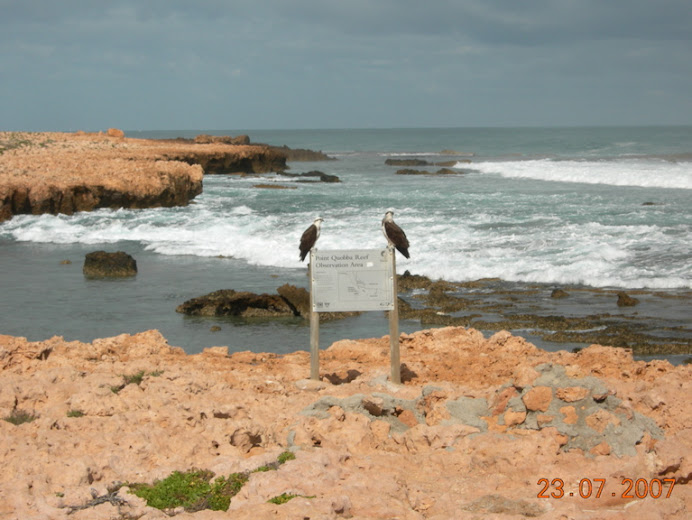
Its a great drive, the recent rain has bought all the flowers out in the desert and we skirt the McCleod Lake to Quobba, blow hole capital!! Another breathtaking piece of coastline with the most incredible jets of water shooting up to 50-100 feet in the air as a front drop to a coastal swell of titanic proportions crashing onto the coastline and breaking on the reefs which fringe the coast. We stop for a little
snorkel in the bay. The water is not so clear due to the swell I imagine but it is a great little bay full of conflicting currents from the inlets and surprisingly good life on the reef. A stop for a Blowhole experience with photos...next stop Coral Bay.
Still Denham has a wealth of things to do and we are going to do them all. First off snorkelling equipment and then to the beach. Snorkel for hours, nothing to see but the water is gorgeous...and what a sunset...this is definately not Slough!
Over the next few days we do the sights! We swim with dolphins at Monkey Mia, they are such perceptive animals and are very tame here, they are fed in the morning but not at any other times as they have a propensity to get lazy - then not go fishing for themselves or teach the little pups how to catch dinner. One pup this year has already died from starvation.
The following day we go to Whalebone and Shell beaches. Both beautiful places in this empty landscape where you are unlucky if you are not the only visitors. There is so much space and so much unspoilt coastline. The coast from Perth to Exmouth is 1800km -ish and then you have another 1000 or so km to Broome with only 6 or 7 small centres of population. Things are changing though and the area is in boomtime with the mines in the north desperate for workers and shortages of people all the way up the coast. Tourism is taking off but the only way to travel is in a camper and it really does feel like a frontier area with most of the roads having only recently been paved but they still flood if the rains come...which, rather surprisingly, they frequently do. This gives the whole area a carpet of light green and small flowers break out over the entire desert..thus the 'Flower State'
We also visit Eagle Bluff which is a meeting place for all kinds of Planktonics. Sharks, dugongs, turtles etc all come into the bay to feed and chat. The whole of Sharks bay is a marine reserve and covers some 24000km2 which is practically all carpeted in sea grass. The depth of the bay is sometimes only 4m and it traps the seawater in pockets. These pockets are distinct areas which have high salt concentrations becoming hypersaline. The species of animals that inhabit these hypersaline areas are thus distinct to these pockets and adapt specifically to the local conditions. Thus you find specialist animals which are found nowhere else on the coast or in the world. New species of animals are constantly being found in Sharks Bay and there is no sign that there is any shortage of new ones, just not enough scientists looking for them.
In the campsite there is a wealth of people and some fantastic characters and similar to the animals around here I imagine they are not found anywhere else in the world (except Earls Court obviously). They are colourful in their character, in their speech and stories and they are incredibly friendly, open, hospitable people who seem to enjoy every day for the 'hell of it'! I really like them. We have met Des and Annette, both psychologists (worrying) and they are great fun and a mine of information. They have the most gorgeous Labradoodle called Lizzie who is complete character and we want to steal her away and take her north. This is not practical.
Dirk Hartog Island is tomorrow and the anticiaption is killing Fo...more spaghetti then to quell this over excitement........
....as a descendant of William Dampier I am honoured to write this piece of the blog -our trip to Dirk Hartog Island where Will landed in 1699 on his commissioned 'voyage to New Holland'. He had thoughfully written the coordinates down in his navigators log and so we landed at exactly the same spot of the island - now known as Dampier's Landing. Luckily for us we had a travelling companion and explorer Leon Deschamps, local Denham lad and acute Dampier nut - there is nothing he doesn't know about Dampier, Dirk Hartog, turtles and aboriginal pursuits to name but a few subjects.
We were all fascinated - including Heath and Byron our friendly seadog brothers.
We swam ashore to behold the low dunes just as Dampier had descibed them and a paradisical beach skirted with beautiful aquamarine shallows. Dampier collected and recorded 24 species of flora from the west coast of Oz, many from this exact point and his specimens still exist today in the herbarium at Oxford University. So I set about emulating my life-long hero and attempted to identify and collect the same species Dampier had 300 years ago. It was not difficult - my first step onto shore and I could see cuttle fish 'shell's' all across the tide line stretching away to the east. Dampier is attributed with the discovery and naming of the cuttle fish in the annals of natural history as well as the avacado, an archipelago, Sharks Bay itself and the word 'barbeque' to name but a few. He was quite a bashful fellow and didn't feel the need to name his discoveries after himself - sometimes losing the kudos of discovery thereafter.
We trod carefully through the bush and came upon the commemorative plaque installed at the site where he was expected to have collected his samples on August 17th 1999 exactly 300 years after he first set foot. Sadly we were reminded of 21st century man here where a plastic clad windswept barbeque (would you believe) blew in shredded tatters across our horizon. Leon was positively embarrassed.
We made our own discovery while on the beach - a magnificent armpour-plated crab with golden hairy legs and claws - hopefully a new sub-species (also a Dampier word)to be attributed to a Dampier in 2007!
We sadly had to leave Dampiers Landing if we were to sail round to Turtle Bay another haunt of Wills, and poor Leon and Byron had the unenviable job of hauling aboard this super slim torso. Talking of humpbacked whales, one very courteously breached before us as we rounded Cape Inscription - this was turning into the BEST day. The steep red cliffs of Turtle Bay loomed in front of us and again a beautiful beach with an array of shells and plants , and a sad little loggerhead turtle cemetry half way up the cliff - their husks baked in the sun. Leon speculated they had been taken by seabirds for a turtle meat lunch - but I wondered if they weren't washed up there during a storm as there were so many in one place.
This was another magical backdrop of family (and world) history with still a few more in Western Oz to go - sayonara Sharks Bay - we will return.....
It is sad to leave Denham, the campsite full of 'Go West' characters but Coral Bay calls and we have to go via Carnarvon...Wales?? On the way to Wales we stop off at Hamelin Pool, an old Telegraph Station, famous in itself as a telegraph station but an older more important living thing lurks here (and not the knotty old relic who sold me a cornetto. Here, in ancient reefs off the beach, are to be found stromatolites, the first living things to inhabit our planet 3.5 billion years ago and they are still slowly going about their business now. Single celled animals which grow only 1cm a year in a, leaving their skeleton behind in the form of prehistoric and pre 'National Desigh Awards' totally random lumps which to the untrained eye may be an insignificant blob. Not so these animals give off small amounts of oxygen which then accumulated over 2 billion years to give us our primeval oxygen rich atmosphere...so in effect the 'big daddy' of us all! Magnificent.
We stay the night in Carnarvon and they arrange a firework display for us, the charm offensive goes on. Its a day of revelling and boozing and they have indulged. There are merry folk everywhere and lots of people swigging out of highly suspicious bottles of coke.
We set off north again after a coffee and egg and bacon not...McMuffin from a charming Coffee shop in Carnarvon. We set off sated for the Blow Holes just up the coast.
Its a great drive, the recent rain has bought all the flowers out in the desert and we skirt the McCleod Lake to Quobba, blow hole capital!! Another breathtaking piece of coastline with the most incredible jets of water shooting up to 50-100 feet in the air as a front drop to a coastal swell of titanic proportions crashing onto the coastline and breaking on the reefs which fringe the coast. We stop for a little
snorkel in the bay. The water is not so clear due to the swell I imagine but it is a great little bay full of conflicting currents from the inlets and surprisingly good life on the reef. A stop for a Blowhole experience with photos...next stop Coral Bay.
Thursday, 12 July 2007
Adelaide to Perth - The Nullabur Plain
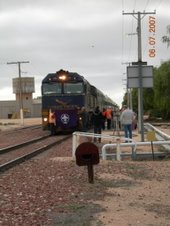
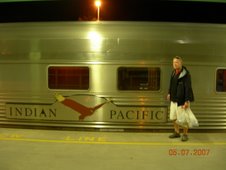
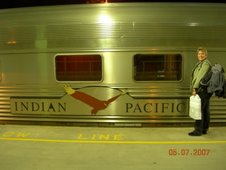
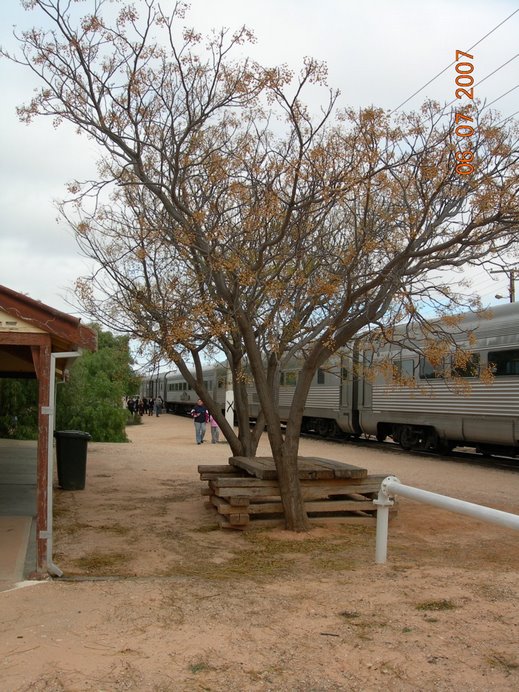
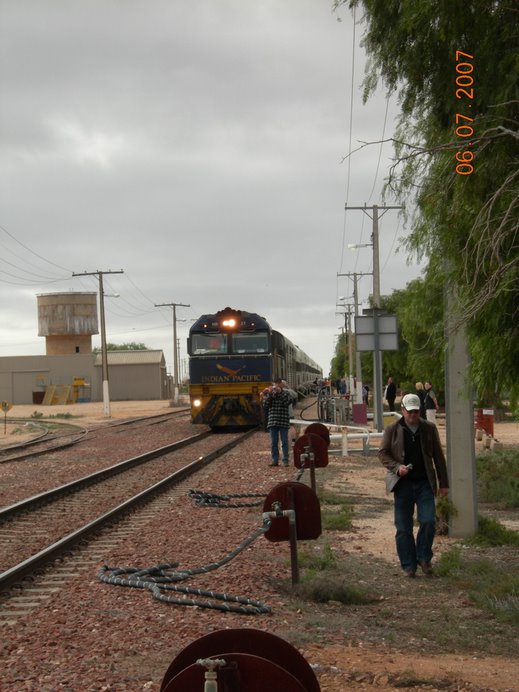
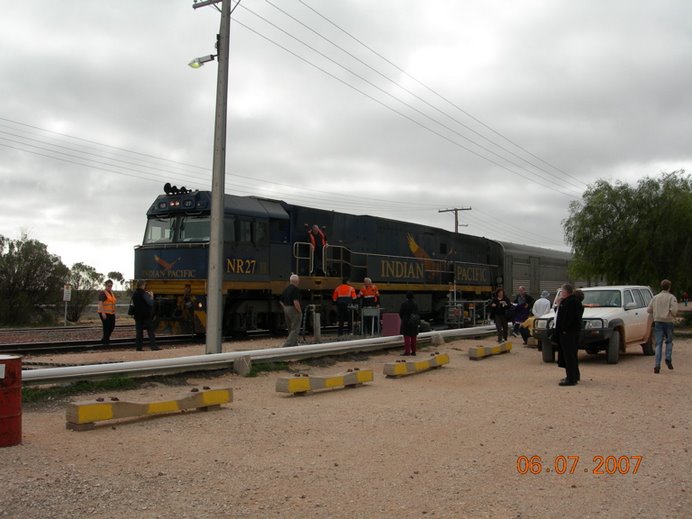
All aboard the Indian Pacific – came over the tannoy in Adelaide rail station. A wonderful locomotive with silver grey carriages freshly washed for the similarly grey nomadic passengers. We jumped into Red Kangaroo class, very middle of the range – and cheerily laughed when shown to our sleeper cabins, the same size as your kitchen table. Not much snoring room for two chunky virgo's!
Across the Nullabour we voyage with 3000kms to go gaping at the soon-to-be-familiar vision of blue-grey low lying shrubbery speckled onto a deep terracotta backdrop , the occasional tree, there when you go to sleep and there when you wake up 7 hours later. At least a feeling of consistency.
When you spend time in an enclosed space with strangers from all corners of the globe,whether it be on board a Chilean ferry or an Australian train you certainly get to know their characters and habits enough to write a book, no less! I enjoy people watching at the best of times and I enjoy more trying to guess creatively their lives and places of work, why are they travelling, who have they left behind? This journey was no exception and we had a glorious time spying on (and being ignored by) those wealthy types in up-market Gold class who had their beds turned down and a 5 course gourmet meal with a selection of superior wines , Australian only of course. (We had what suspiciously looked like British Rail sandwiches turning up at the corners due to the air miles!) They had probably made their money investing in the Gold mines of the southwest and had come on this trip to see how their investment was doing at the Superpit in Kalgoorlie where we stopped for a few hours one evening. Kalgoorlie is a fascinating mining town before, after and during the goldrush and we were lucky enough to have the most amusing tour guide who was hell bent on showing us among other buildings, the houses belonging to the local hookers and their red lights. Luckily for the ermine clad elite, gold mining is going through a huge BOOM! and the giant pit (largest opencast mine in the world) full of seemingly dinky toy trucks it was so deep, produces 1 tonne of gold per day!! 'No worries' as they say out here - none at all it would seam!( 'Scuse the pun)
Everybody in Red Kagaroo class became familiar with a family of four children all under 8 yrs with the most patient amazonian mother and the naughtiest 3 year old Oscar running up and down the corridors in the sleeping carriages giving us all a wake up call at 5.30 am. His brothers and sister invariably locked him out of their carriage for a bit of peace I imagine so he could scream and yell making sure nobody else had any, until he was let in. "Oh so your'e Oscar' each grey haired occupant would say when they emerged blearily from their undersized carriage. He will be quite a character one day. When we arrived I was happy to note mum and all four kids were greeted at Perth, by her equally amazonian sister and three cousins. What a school holiday this will be - I wonder how may Dads would have made the same trip across the Nullabor?
Arriving in Perth we had the fortune to meet up with kindly friends of Sheryl Campbell whom we had spent many an hour chatting to on the Navimag trip in Chile, and they gave us valuable guidance on places to visit and how not to be run over by kangaroos on manouvres while driving our camper through the bush as we proceeded up the west coast of Australia. Perth is a beautiful city , spacious and green with wide avenues and stunning scenery, capped by Kings Park overlooking the city and Swan river. Here we whiled away many an hour tramping about the 1000 acres of botannical beauty and gazing humbly at the memorials of those who gave their lives through Australian history. It is a serene place of reflection in a stunning position.
In Freemantle the victorian buildings of worth still stand preserved with reverence contrasting with the innovative modern architecture of the Western Australian Maritime Museum . Here I was fortunate enough to meet Dr Mick McCarthy, Curator, marine archaeologist and professed Dampier fan who dived onto the wreck of Dampiers leaky ship the Roebuck, where it sank in Acension Island. His team, within the first hour of the expedition, salvaged the ships bell and a giant clam from Williams shell collection that went down with the ship. Fascinating stuff! I have to thank Mac for all his encouragement and guidance towards my plans of hopefully contributing further to the profile raising of old Uncle Willliam. You never know, my dreams may yet to come to fruition!
Across the Nullabour we voyage with 3000kms to go gaping at the soon-to-be-familiar vision of blue-grey low lying shrubbery speckled onto a deep terracotta backdrop , the occasional tree, there when you go to sleep and there when you wake up 7 hours later. At least a feeling of consistency.
When you spend time in an enclosed space with strangers from all corners of the globe,whether it be on board a Chilean ferry or an Australian train you certainly get to know their characters and habits enough to write a book, no less! I enjoy people watching at the best of times and I enjoy more trying to guess creatively their lives and places of work, why are they travelling, who have they left behind? This journey was no exception and we had a glorious time spying on (and being ignored by) those wealthy types in up-market Gold class who had their beds turned down and a 5 course gourmet meal with a selection of superior wines , Australian only of course. (We had what suspiciously looked like British Rail sandwiches turning up at the corners due to the air miles!) They had probably made their money investing in the Gold mines of the southwest and had come on this trip to see how their investment was doing at the Superpit in Kalgoorlie where we stopped for a few hours one evening. Kalgoorlie is a fascinating mining town before, after and during the goldrush and we were lucky enough to have the most amusing tour guide who was hell bent on showing us among other buildings, the houses belonging to the local hookers and their red lights. Luckily for the ermine clad elite, gold mining is going through a huge BOOM! and the giant pit (largest opencast mine in the world) full of seemingly dinky toy trucks it was so deep, produces 1 tonne of gold per day!! 'No worries' as they say out here - none at all it would seam!( 'Scuse the pun)
Everybody in Red Kagaroo class became familiar with a family of four children all under 8 yrs with the most patient amazonian mother and the naughtiest 3 year old Oscar running up and down the corridors in the sleeping carriages giving us all a wake up call at 5.30 am. His brothers and sister invariably locked him out of their carriage for a bit of peace I imagine so he could scream and yell making sure nobody else had any, until he was let in. "Oh so your'e Oscar' each grey haired occupant would say when they emerged blearily from their undersized carriage. He will be quite a character one day. When we arrived I was happy to note mum and all four kids were greeted at Perth, by her equally amazonian sister and three cousins. What a school holiday this will be - I wonder how may Dads would have made the same trip across the Nullabor?
Arriving in Perth we had the fortune to meet up with kindly friends of Sheryl Campbell whom we had spent many an hour chatting to on the Navimag trip in Chile, and they gave us valuable guidance on places to visit and how not to be run over by kangaroos on manouvres while driving our camper through the bush as we proceeded up the west coast of Australia. Perth is a beautiful city , spacious and green with wide avenues and stunning scenery, capped by Kings Park overlooking the city and Swan river. Here we whiled away many an hour tramping about the 1000 acres of botannical beauty and gazing humbly at the memorials of those who gave their lives through Australian history. It is a serene place of reflection in a stunning position.
In Freemantle the victorian buildings of worth still stand preserved with reverence contrasting with the innovative modern architecture of the Western Australian Maritime Museum . Here I was fortunate enough to meet Dr Mick McCarthy, Curator, marine archaeologist and professed Dampier fan who dived onto the wreck of Dampiers leaky ship the Roebuck, where it sank in Acension Island. His team, within the first hour of the expedition, salvaged the ships bell and a giant clam from Williams shell collection that went down with the ship. Fascinating stuff! I have to thank Mac for all his encouragement and guidance towards my plans of hopefully contributing further to the profile raising of old Uncle Willliam. You never know, my dreams may yet to come to fruition!
Wednesday, 11 July 2007
Melbourne to Adelaide
Leaving Sydney behind we head down Highway 1 on the first leg of our road trip round Australia. I am excited - the wind through my hair and another capacious hot chocolate in my tum we head for the hills - well the coast actually that lies between Sydney and Melbourne . The little corolla straining under the weight of our ever growing book collection we drive through plenty of eucalyptus forests not passing many cars at all which is, I am warned by the wise old fruit next to me, something I'd better get used to - oh,and its raining. No, I mean raining ,,,,hard. New South Wales and Victoria have been on desperate measures for 3 years without a single drop of rain and resevoirs at all time lows of 23% and the like - and all they had to do was invite a little known Dampier to stay and the whole place suddenly gets a lot more dampyer - hic!
Battling through the never ending forests of gum and the sound of it being rapaciously chewed in my ear by the now 18 months (and counting) non smoker we hole up in a pretty lagoonside town of Merimbula in a hotel motel with a peculiar sense of spatial design. The tumbleweed rolled past us down the deserted street as we attempt vainly to find a cafe, restaurant or front parlour open and warmly welcoming the disconsolate heroes with huge pies or roast of the day - and it was only 8pm. Eventually we had to 'knock up' a kindly Thai grandmother who was putting her bed socks on behind the CLOSED sign on the door and persuaded her to knock us up a quick chicken sate which we ate salaciously back 'home'.
Dawn broke behind a wall of water and leaving still fewer local smiling faces behind we set off towards Melbourne hoping to reach Bairnsdale for the next stop. We took a brave guess that this was not going to happen as we left New South Wales and progressed into Victoria....underwater. The bridge over the River Mitchell had been obscured by the torrent which had burst its banks -the road was closed. We were steered to stop overnight (but more likely 3 nights) at Lakes Entrance, the attractive tourist spot where several rivers converge into inland lakes that only a strip of land,the said township, and miles of stringy dunes,separates lake from ocean. This is where we should have used our combined MENSA score of 408 to work out that torrential rivers converge into lakes which overflow into...Lakes Entrance, and they did exactly that - into our motel car park overnight. So upon rising we were faced with the news that 3 lakes and four rivers were approaching from the rear and the full moon promised the highest tide of the year from the front - hmmn, time to leave. It became a humbling experience driving gingerly through little villages completely awash with river water, only the cross bar of the soccer goal visible above the swirling muddy soup and trees buried underwater almost to their tops. As we left the flood plains and climbed up towards melbourne the sheep in fields by the road gradually became whiter and cleaner - as they found higher ground.
We arrived in Melbourne to a very warm and fluffy welcome from Nicole and Julian, the highly fit and intelligent thirty somethings we had the pleasure to meet in El Calafate, Argentina on the Perito Merino Glacier. Would Mark manage a week of vegetarian fayre I wondered to myself as his face contorted at the sight of Lentil and Kidney Bean soup with extra pulses, vainly trying to pluck off the white hairs sticking to his black fleece, courtesy of Nic and Julians little princess, Chebbie. Seriously, we had a wonderful time slobbing out in their smart flat while they commuted to their highly important work places, interspersing huge cooked breakfasts with strenuous trips to art galleries and museums, Federation Square and the Luna Fun Park in St Kilda. Here our friendly Melbournians decided to pay me back for my slovenly ways by frightening me out of my pants on the oldest roller coaster on the planet seemingly made of balsa wood and old chewing gum and having a remarkable propencity to sway in time with the gusts of wind and rain. Thanks guys..... The other highlight of our stay was the nail biter game of rugger at the amazing MCG stadium between the All Blacks and the Wallabies - Mark knew, of course , the Aussies would win and they did - don't they always win everything??!
With a short 50 minute hop to Adelaide by air and our white fur covered luggage in tow, we arrived to be met by another old KJC school friend Jeremy Goldfinger, who seemingly has struck gold in his garden or won a bundle on Canasta in the Casino Royale in Monte Carlo! The lovely Vicky, a woman of the greatest patience, sweet Laura and vivacious Matt in his wedding dress greeted us at wind and rain swept Goldeneye Castle making us very comfortable and replete, and helped us watch Wimbledon late into the night. The following day we ventured together down to the coast to tiny seaside village of Sellecks where Gold-Bond has a beach house to see how it had faired after the storm and heigh ho, how small this world is, Trents parents live down the street behind! So a merry meeting was had by all where old friends met new and hopefully last as long as Goldenpants run of luck at the Casino!
With sage words of advice about investments and MI5 Jeremy dropped us at the Adelaide train station for the next leg of the trip boarding the Indian Pacific sleeper train to cross the Nullabur Plain to Perth. Grey nomads brigade - we were searching for our bus passes before we realised we still have fourteen years to go - and 3000kms - you just get carried away with the ambience of it all!
Battling through the never ending forests of gum and the sound of it being rapaciously chewed in my ear by the now 18 months (and counting) non smoker we hole up in a pretty lagoonside town of Merimbula in a hotel motel with a peculiar sense of spatial design. The tumbleweed rolled past us down the deserted street as we attempt vainly to find a cafe, restaurant or front parlour open and warmly welcoming the disconsolate heroes with huge pies or roast of the day - and it was only 8pm. Eventually we had to 'knock up' a kindly Thai grandmother who was putting her bed socks on behind the CLOSED sign on the door and persuaded her to knock us up a quick chicken sate which we ate salaciously back 'home'.
Dawn broke behind a wall of water and leaving still fewer local smiling faces behind we set off towards Melbourne hoping to reach Bairnsdale for the next stop. We took a brave guess that this was not going to happen as we left New South Wales and progressed into Victoria....underwater. The bridge over the River Mitchell had been obscured by the torrent which had burst its banks -the road was closed. We were steered to stop overnight (but more likely 3 nights) at Lakes Entrance, the attractive tourist spot where several rivers converge into inland lakes that only a strip of land,the said township, and miles of stringy dunes,separates lake from ocean. This is where we should have used our combined MENSA score of 408 to work out that torrential rivers converge into lakes which overflow into...Lakes Entrance, and they did exactly that - into our motel car park overnight. So upon rising we were faced with the news that 3 lakes and four rivers were approaching from the rear and the full moon promised the highest tide of the year from the front - hmmn, time to leave. It became a humbling experience driving gingerly through little villages completely awash with river water, only the cross bar of the soccer goal visible above the swirling muddy soup and trees buried underwater almost to their tops. As we left the flood plains and climbed up towards melbourne the sheep in fields by the road gradually became whiter and cleaner - as they found higher ground.
We arrived in Melbourne to a very warm and fluffy welcome from Nicole and Julian, the highly fit and intelligent thirty somethings we had the pleasure to meet in El Calafate, Argentina on the Perito Merino Glacier. Would Mark manage a week of vegetarian fayre I wondered to myself as his face contorted at the sight of Lentil and Kidney Bean soup with extra pulses, vainly trying to pluck off the white hairs sticking to his black fleece, courtesy of Nic and Julians little princess, Chebbie. Seriously, we had a wonderful time slobbing out in their smart flat while they commuted to their highly important work places, interspersing huge cooked breakfasts with strenuous trips to art galleries and museums, Federation Square and the Luna Fun Park in St Kilda. Here our friendly Melbournians decided to pay me back for my slovenly ways by frightening me out of my pants on the oldest roller coaster on the planet seemingly made of balsa wood and old chewing gum and having a remarkable propencity to sway in time with the gusts of wind and rain. Thanks guys..... The other highlight of our stay was the nail biter game of rugger at the amazing MCG stadium between the All Blacks and the Wallabies - Mark knew, of course , the Aussies would win and they did - don't they always win everything??!
With a short 50 minute hop to Adelaide by air and our white fur covered luggage in tow, we arrived to be met by another old KJC school friend Jeremy Goldfinger, who seemingly has struck gold in his garden or won a bundle on Canasta in the Casino Royale in Monte Carlo! The lovely Vicky, a woman of the greatest patience, sweet Laura and vivacious Matt in his wedding dress greeted us at wind and rain swept Goldeneye Castle making us very comfortable and replete, and helped us watch Wimbledon late into the night. The following day we ventured together down to the coast to tiny seaside village of Sellecks where Gold-Bond has a beach house to see how it had faired after the storm and heigh ho, how small this world is, Trents parents live down the street behind! So a merry meeting was had by all where old friends met new and hopefully last as long as Goldenpants run of luck at the Casino!
With sage words of advice about investments and MI5 Jeremy dropped us at the Adelaide train station for the next leg of the trip boarding the Indian Pacific sleeper train to cross the Nullabur Plain to Perth. Grey nomads brigade - we were searching for our bus passes before we realised we still have fourteen years to go - and 3000kms - you just get carried away with the ambience of it all!
Monday, 9 July 2007
Aussie, Sydney
We left New Zealand on a very, very large jet and the flight was rather cool with a great new comedy on the streets called 'Wild Hogs'. John Travolta is even funnier than when he was packing a pair of pop socks in his spandex pipes in SNF. Its a great Mid-life crisis spoof with Home Improvement man 'Tim' and lots of Harleys.
We arrive in Sydney and it looks even bigger from the air than i remember, still gorgeous after all these years. We pick up a compact and make for Bondi beach, it's only 5pm and a sundowner would be fabbo on the beach with a view of the ocean.
They have really cleaned Bondi up and there are walkers, joggers and gentlefolk everywhere. Sundowner and then off to Nick and Nickys in Clovelly. Great to see N&N again and Alice has shot up and is gorgeous 14's.
Next day is to Manley at dawn to meet Trent and pick up the keys to his flat. Manley is still the most beautiful place with the fir trees round the bay and the esplanande full of joggers and cyclists. Trent is looking good and we get to chat before he is off to Melbourne. Down to the Steyne Cafe for breakie...memories are made of this.
Spend the day in Manley and then back to Randwick. We take a walk with Nicky and Lucy - the Labadoodledandy - to Bronte and Coogee beach. Surf is totally up and the surfers are giving it their all in 8 - 10m waves. Back to Cafe city in Coogee and a gorgeous lunch - for Lucy too as she cleans up the pizza crusts littering the pavement. Sydney is awash with Cafes, restaurants and people eat out here..and who can blame them when you sre surrounded by sea air and blue sky...ad this is mid winter.
Saturday we get down to Bronte fo breakie and then get our swim gear and get down to the sea-water pool where Nicky get washed around like a washing machine while swimming and Nick and i do a teenage thing and Rail-Jump at the edge of the pool with the waves crashing over the top...its sensational!!!
Fo does lots of work for the book by visiting the museum in town where there is tons of stuff from the buccaneering past. There is also two replica boats in the harbour....Endeavour and The Bounty and they look so small!!! How did they survive with so little room and so many people on board??
Well to cap it all, unbelievably, the Opera House is showing the Barber of Seville, bit of favorite Opera and we get tickets. The Opera House is really something and to arrive for a large show in the main auditorium with the Chatterati of Sydney (not discussing butter) is top potato. This is the opening night and the Auditorium is full, the actors are already on stage lolling and chatting waiting forthe gun. The set is sumptuous and Gaudi-esque with great curvaceous features, rich colours complimented with lush costumes for the actors. The whole show is delicious, Rosina sings like a lark, the story holds, the singing tight with beautiful nuances in the acting. Alice whispers to Nicky at half time 'don't ever bring me to the Opera again' but i think she enjoyed the second half which has much stronger sections. I remember seeing 'La Clemenza de Tito' - Mozart and feeling exactly the same as Alice...It was more mindnumbing than watching the England Footie team...sorry Amadeus, that is harsh...England football makes Jonathan Ross look interesting!!! Pah, anyway my highlight of the trip so far...sorry Machu Picchu, more songs, dance and light hearted orchestration to tickle the fancy.
There is a small bar on the level behind the auditoriim where you have the half time drinks...the view over the habour is beautiful and the bridge is lit up in the left corner, the whole harbour and bays lit up to the right and i think you can see the fair on the north bank with the Ferris wheel standing out like a catherine wheel...although the view of the NCP car park behind the Hexagon in Reading still resonates!!!
We leave Sydney omorrow but this will stay in the memory for a long time. Ta ta Sydney....
We arrive in Sydney and it looks even bigger from the air than i remember, still gorgeous after all these years. We pick up a compact and make for Bondi beach, it's only 5pm and a sundowner would be fabbo on the beach with a view of the ocean.
They have really cleaned Bondi up and there are walkers, joggers and gentlefolk everywhere. Sundowner and then off to Nick and Nickys in Clovelly. Great to see N&N again and Alice has shot up and is gorgeous 14's.
Next day is to Manley at dawn to meet Trent and pick up the keys to his flat. Manley is still the most beautiful place with the fir trees round the bay and the esplanande full of joggers and cyclists. Trent is looking good and we get to chat before he is off to Melbourne. Down to the Steyne Cafe for breakie...memories are made of this.
Spend the day in Manley and then back to Randwick. We take a walk with Nicky and Lucy - the Labadoodledandy - to Bronte and Coogee beach. Surf is totally up and the surfers are giving it their all in 8 - 10m waves. Back to Cafe city in Coogee and a gorgeous lunch - for Lucy too as she cleans up the pizza crusts littering the pavement. Sydney is awash with Cafes, restaurants and people eat out here..and who can blame them when you sre surrounded by sea air and blue sky...ad this is mid winter.
Saturday we get down to Bronte fo breakie and then get our swim gear and get down to the sea-water pool where Nicky get washed around like a washing machine while swimming and Nick and i do a teenage thing and Rail-Jump at the edge of the pool with the waves crashing over the top...its sensational!!!
Fo does lots of work for the book by visiting the museum in town where there is tons of stuff from the buccaneering past. There is also two replica boats in the harbour....Endeavour and The Bounty and they look so small!!! How did they survive with so little room and so many people on board??
Well to cap it all, unbelievably, the Opera House is showing the Barber of Seville, bit of favorite Opera and we get tickets. The Opera House is really something and to arrive for a large show in the main auditorium with the Chatterati of Sydney (not discussing butter) is top potato. This is the opening night and the Auditorium is full, the actors are already on stage lolling and chatting waiting forthe gun. The set is sumptuous and Gaudi-esque with great curvaceous features, rich colours complimented with lush costumes for the actors. The whole show is delicious, Rosina sings like a lark, the story holds, the singing tight with beautiful nuances in the acting. Alice whispers to Nicky at half time 'don't ever bring me to the Opera again' but i think she enjoyed the second half which has much stronger sections. I remember seeing 'La Clemenza de Tito' - Mozart and feeling exactly the same as Alice...It was more mindnumbing than watching the England Footie team...sorry Amadeus, that is harsh...England football makes Jonathan Ross look interesting!!! Pah, anyway my highlight of the trip so far...sorry Machu Picchu, more songs, dance and light hearted orchestration to tickle the fancy.
There is a small bar on the level behind the auditoriim where you have the half time drinks...the view over the habour is beautiful and the bridge is lit up in the left corner, the whole harbour and bays lit up to the right and i think you can see the fair on the north bank with the Ferris wheel standing out like a catherine wheel...although the view of the NCP car park behind the Hexagon in Reading still resonates!!!
We leave Sydney omorrow but this will stay in the memory for a long time. Ta ta Sydney....
Monday, 18 June 2007
New Zealand, South of the North
As we headed south to the south of the North Island which is north of the north of the South Island...thats for people who have bird flu...we had to stop in at Auckland just to pick up my Ipod which broke down on the first day in Argentina and never worked again, which isn't a bad thing but it would be great to hear some Van the Man again. We needed a new car as well as the X-trail isn't up to the task which we set for it!
We headed towards Hamilton to catch up with Peter and Nikki who lived on the outskirts. Stayed in downtown Hamilton for the night, went for another double drizzled dinner and were serenaded by a the Karaoke Bar over the road.
The next morning we caught up with Nikki and Peter who live to the south of Hamilton on the way to Cambridge. Peter harks from Henley and Nikki from Winchester and we caught up with the news from both sides. Cambridge is a bit of an equine centre with many famous horses trained here for flat racing and if you were top of your game you are immortalised with a pavement brass in downtown Cambridge..much like the hand prints on Sunset.
We leave Peter and Nikki, but we are coming back on the return journey. Next stop is New Plymouth in the shadow of Mount Taranaki. We are also catching up with Emma and Petit who are coming from Wellington and the opposite way round the mountain to New Plymouth, past all the surf sites to the west of the Volcano. We meet by the wind clock in the morning - a 90m high fibreglass rod with a small bulb on the tip - and head for Mount Taranaki park which runs around the base of the volcano. Its a long an winding road to the car park half way to the top and we have a great walk through the 'Hobbit Woods' before having tea and cake from the 'bed on wheels' in the car park.
Into town for pool and beer and Emma and Petit are asked what their parents (thats us) would like to drink? Aarrggghhhh, we are not grey nomads, we are not grey nomads!!!
We say goodbye to our kids the next morning but we are meeting in Lake Taupo. We head for the Forgotten Highway 43 which runs from New Plymouth all the way west past the Matemateaonga Range, through extraordinay volcanc scenery, and leads to Lake Taupo. On the way we meet the hogs fence of all hog fences with up to 100 wild boar skins laid end to end as far as the eye can see. We stop at a crossing and there are two hog hunters and a gentlewoman from the hills chatting about butter standing in the middle of the road. She explains that the skins are sabre rattling in the hog hunters parlance and this is big skin street. we accelerate fast towards nowhere but away from toon town.
Next stop is Lake Taupo. Find a place to take our kids as well and cook a well earned meal after shopping at Woolies. We overdo the shop but ths is a rare treat ....a kitchen with white mans oven and microwave. Great spaghetti, ecoutrements, chocolate ad television.
Lake Taupo is a divine volcanic event with the lake being the water filled remnant of a super-eruption. North is the two peaks
which mark the extent of the volcano and give some good skiing and restaurants half way up the hill for the faint hearted. We charter a plane...'cos we are that wealthy...and fly over the mountains through cloud to 1500m, Pureora and Hauhungaora are both majestic and covered with permanent snow. The volcanic lakes bubble with gas and sulphur slicks cover the water surface.
Emma and Petit arrive the next morning in torrential rain. We have to face the Golf challenge on the lakeside. Its 128 yards to the green floating in te middle of the lake and you can win $5000 if you can get a hole in one...its fun having a go and remarkably its happens once every two weeks! We return to pool, six holes and a 2m total length to the table.
We set off for Rotorua early in the morning and make for the Geyser park. The Geysers run constantly while we are there.
We retire to the town for lunch and then to the hot water baths for massage and a loll in the baths which vary between warmish to hot enough to worry a haggis.
Emma and Petit get on their way in the love bug and we have a date back with Nikki and Peter in Hamilton. We get back via Hawkes Bay and Whakatane which is truly beautiful with so few people, remote rolling scenery and beaches, deserted and endless. We have also spent the time well in Taupo. Fo proof read a book that Peter is writing about running a Llama racing stud. Llama racing is big in Hamilton and to get the best out of your Llama takes a huge commitment financially and from the jockeys who generally ride side saddle. Its a book that should open the door on the msterious world which will send shock waves through the Andes. Publication should be in 2008.
For the last leg of our tour we cruise through the Coromandel, the north east tip of the island and a sanctuary of rich Auckland guys and galls. We stop in Tairua and explore the coastline including Cooks Beach, Whitianga and Hot Springs Beach. Here the springs run under the beach and Fo takes a bath whilst having a photoshoot...back, just a little, thats it...oops. A very wet bottom, new boots and.... there are beautiful houses, breathtaking scenery and Kauri forests which have survived the ravages visited on their friends in the rest of New Zealand.
Its time to leave NZ. Regrets, I had a few...didn't make it to the south island but it turns out that the North Island is big enough, beautiful and it will remain beautiful if they can recognise trees as their friends...man!
We headed towards Hamilton to catch up with Peter and Nikki who lived on the outskirts. Stayed in downtown Hamilton for the night, went for another double drizzled dinner and were serenaded by a the Karaoke Bar over the road.
The next morning we caught up with Nikki and Peter who live to the south of Hamilton on the way to Cambridge. Peter harks from Henley and Nikki from Winchester and we caught up with the news from both sides. Cambridge is a bit of an equine centre with many famous horses trained here for flat racing and if you were top of your game you are immortalised with a pavement brass in downtown Cambridge..much like the hand prints on Sunset.
We leave Peter and Nikki, but we are coming back on the return journey. Next stop is New Plymouth in the shadow of Mount Taranaki. We are also catching up with Emma and Petit who are coming from Wellington and the opposite way round the mountain to New Plymouth, past all the surf sites to the west of the Volcano. We meet by the wind clock in the morning - a 90m high fibreglass rod with a small bulb on the tip - and head for Mount Taranaki park which runs around the base of the volcano. Its a long an winding road to the car park half way to the top and we have a great walk through the 'Hobbit Woods' before having tea and cake from the 'bed on wheels' in the car park.
Into town for pool and beer and Emma and Petit are asked what their parents (thats us) would like to drink? Aarrggghhhh, we are not grey nomads, we are not grey nomads!!!
We say goodbye to our kids the next morning but we are meeting in Lake Taupo. We head for the Forgotten Highway 43 which runs from New Plymouth all the way west past the Matemateaonga Range, through extraordinay volcanc scenery, and leads to Lake Taupo. On the way we meet the hogs fence of all hog fences with up to 100 wild boar skins laid end to end as far as the eye can see. We stop at a crossing and there are two hog hunters and a gentlewoman from the hills chatting about butter standing in the middle of the road. She explains that the skins are sabre rattling in the hog hunters parlance and this is big skin street. we accelerate fast towards nowhere but away from toon town.
Next stop is Lake Taupo. Find a place to take our kids as well and cook a well earned meal after shopping at Woolies. We overdo the shop but ths is a rare treat ....a kitchen with white mans oven and microwave. Great spaghetti, ecoutrements, chocolate ad television.
Lake Taupo is a divine volcanic event with the lake being the water filled remnant of a super-eruption. North is the two peaks
which mark the extent of the volcano and give some good skiing and restaurants half way up the hill for the faint hearted. We charter a plane...'cos we are that wealthy...and fly over the mountains through cloud to 1500m, Pureora and Hauhungaora are both majestic and covered with permanent snow. The volcanic lakes bubble with gas and sulphur slicks cover the water surface.
Emma and Petit arrive the next morning in torrential rain. We have to face the Golf challenge on the lakeside. Its 128 yards to the green floating in te middle of the lake and you can win $5000 if you can get a hole in one...its fun having a go and remarkably its happens once every two weeks! We return to pool, six holes and a 2m total length to the table.
We set off for Rotorua early in the morning and make for the Geyser park. The Geysers run constantly while we are there.
We retire to the town for lunch and then to the hot water baths for massage and a loll in the baths which vary between warmish to hot enough to worry a haggis.
Emma and Petit get on their way in the love bug and we have a date back with Nikki and Peter in Hamilton. We get back via Hawkes Bay and Whakatane which is truly beautiful with so few people, remote rolling scenery and beaches, deserted and endless. We have also spent the time well in Taupo. Fo proof read a book that Peter is writing about running a Llama racing stud. Llama racing is big in Hamilton and to get the best out of your Llama takes a huge commitment financially and from the jockeys who generally ride side saddle. Its a book that should open the door on the msterious world which will send shock waves through the Andes. Publication should be in 2008.
For the last leg of our tour we cruise through the Coromandel, the north east tip of the island and a sanctuary of rich Auckland guys and galls. We stop in Tairua and explore the coastline including Cooks Beach, Whitianga and Hot Springs Beach. Here the springs run under the beach and Fo takes a bath whilst having a photoshoot...back, just a little, thats it...oops. A very wet bottom, new boots and.... there are beautiful houses, breathtaking scenery and Kauri forests which have survived the ravages visited on their friends in the rest of New Zealand.
Its time to leave NZ. Regrets, I had a few...didn't make it to the south island but it turns out that the North Island is big enough, beautiful and it will remain beautiful if they can recognise trees as their friends...man!
Friday, 1 June 2007
New Zealand - North, The Bay of Islands
Travelling north of Auckland takes you to Northland and the historical home of the Maori culture. There are Maori mission houses - church meeting places, all over New Zealand and every village or settlement has a Maori name within its title somewhere. Although there are not many 'pure' Maori left, the culture is very much part of everyday life with some lessons in all primary schools conducted in the Maori language and religous customs and culture given the same importance than any christian or other dinominational celebrations. And New Zealand is a very patriotic country with the All Blacks being revered every hour on the radio and the Queens birthday celebrations playing a big part in New Zealanders lives with an honorary bank holiday,knock down prices in the shops and street parties. Look to your laurels UK...
Northland is probably the most sub-tropical part of New Zealand plenty of temperate rainforest to see and again we were lucky with the weather - even though technically its winter. We based ourselves in Pahia on the eastern side of the peninsula and had excellent opportunity to take day trips to all parts over the 5 days of our stay. Till I pranged the car that is - no, there were no maltesers involved this time!
Before this minor setback the most memorable places and events in Northland involved
a) being dressed up as giant condoms for the 'Excitor' trip around the beautiful Bay of Islands - I was excited!
b)meeting a couple of wild boars skins hangin' out on a fence of the spooky, dark, unmade 53kms long short-cut we were supposedly driving along to get 'home' in pouring rain; with duelling banjos whispering in our ears we turned around and took the long road
c)the beautiful '90 Miles Beach' which turned out to be 90 kilometres and in desperate need of a cafe at the end!
d)a visit to the Waipapa chocolate factory - mmm, now this could be a serious alternative career - macademia nuts in milk choc slabs, its paradise regained!
While on the daily road trips you can't help but notice the Kiwi penchant for stating the obvious, unusual brandnames, statements or community clubs and peculiar mixtures of foodstuffs on one plate. A road sign invites us to drive down the 'Big Flat Road' or up the 'Right Turn Road' where we pass Frog Whistle Mine to arrive at Whanaroa, 'Small Town, Big Spirit' to shop in the store with 'Knock Down Prices for the Queen - its her Birthday Sale!' We stop for lunch for some exotic 'royally roasted lamb drizzled with banana, avocado oiled vegetables nestling in brandy and sultana gravy' while listening to the Complaint Choir on the radio, complaining about the level of the NZ equivalent to council tax through six part harmony of Handel's Messiah! Phew - I need a holiday!
Northland is probably the most sub-tropical part of New Zealand plenty of temperate rainforest to see and again we were lucky with the weather - even though technically its winter. We based ourselves in Pahia on the eastern side of the peninsula and had excellent opportunity to take day trips to all parts over the 5 days of our stay. Till I pranged the car that is - no, there were no maltesers involved this time!
Before this minor setback the most memorable places and events in Northland involved
a) being dressed up as giant condoms for the 'Excitor' trip around the beautiful Bay of Islands - I was excited!
b)meeting a couple of wild boars skins hangin' out on a fence of the spooky, dark, unmade 53kms long short-cut we were supposedly driving along to get 'home' in pouring rain; with duelling banjos whispering in our ears we turned around and took the long road
c)the beautiful '90 Miles Beach' which turned out to be 90 kilometres and in desperate need of a cafe at the end!
d)a visit to the Waipapa chocolate factory - mmm, now this could be a serious alternative career - macademia nuts in milk choc slabs, its paradise regained!
While on the daily road trips you can't help but notice the Kiwi penchant for stating the obvious, unusual brandnames, statements or community clubs and peculiar mixtures of foodstuffs on one plate. A road sign invites us to drive down the 'Big Flat Road' or up the 'Right Turn Road' where we pass Frog Whistle Mine to arrive at Whanaroa, 'Small Town, Big Spirit' to shop in the store with 'Knock Down Prices for the Queen - its her Birthday Sale!' We stop for lunch for some exotic 'royally roasted lamb drizzled with banana, avocado oiled vegetables nestling in brandy and sultana gravy' while listening to the Complaint Choir on the radio, complaining about the level of the NZ equivalent to council tax through six part harmony of Handel's Messiah! Phew - I need a holiday!
Wednesday, 23 May 2007
New Zealand : Auckland - Waiheke Island
Landing in a new country at 4am having crossed the time and date line means you miss out a whole day in your life and get to know the internal workings of the airport for a few wee hours with a thumping head - mmn, jet lag! Once Auckland was rubbing its eyes awake we had a very informative taxi ride to Hotel Duxton, right in downtown, provided by a chatty Kiwi seik. The hotel was a revelation as we had our own kitchen and washing machine in our room and the chance to cook our first meal for three months. Bliss!
Auckland is a pretty and compact city, a similar size to Reading (admittedly on the large side of pretty and oceanside), but with more Asians, especially Koreans! Every second person was Korean who we found out were there for English language courses (cheapest place in the world to conjugate) and to work in every shop and cafe within the city's environs. So far quite an unusual introduction to this far flung haven of the British Commonwealth. We spent a gut churning few hours 190 metres above the city in the Sky Tower, feeling a little nauseous each time a fearless sky jumper hurtled past our noses at the speed of extreme light (they throw themselves off the tower attached to a wire from just above the cafe) The views were outstanding and gave us a sparkling geographical summary of this welcoming city. The viewing map included the Coromandel peninsula and the youthful volcanic islands in the harbour - which was our first introduction to Waheike where Mike and Karen have settled after leaving England a few years ago. Looking forward to catching up with them as I haven't seen Mike since supping Pimms at Wimbledon 4 or so years ago when he first mentioned NZ as a possibility. We celebrated our arrival with a Thai meal at 'Mai Thai' right next door. Lashings of green curry and a generous helping of Pad Prik.
Met up with Dr Karen who has a health centre in the port area of town, took the chance to moan to Dr Andrew, (one of Karens colleagues) about middle age spread, hair loss and various pains I had in all moving parts of my poor body and got some pills to stop my legs falling off in Starbucks...all is well! We caught a ferry with Karen for the 40 minute ride to Waiheke...and the harbour area of Auckland is stunning. Little volcanic islands poking up from the bay; even a nature reserve slap bang in the middle..striking similarities to the trip from Sydney to Manley. Mike, Karen, Jed (9) and Alfie (7) live in a fabulous architect designed state-of-the-art home overlooking Dead Dog Bay - all those episodes of Grand Designs I had watched intently suddenly rolled into one. We were esconced in the 'weekender' on the far side of the tennis court so we could burp and rest in peace while our hosts went about their daily business, such as going to work and school. The gardens were laid to vineyard below the house and then into gentle forest towards the bay which was deserted and gorgeous. The weather was glorious and walking tracks were trod, fish were caught, wine was tasted at vineyards, and cocktail parties were attended (in camping fleeces that looked a little worse for wear and smelt of fish and bonfires - a new cologne by 'Shabby old Brits'!) At the cocktail party Fo hooked up with a a local island heiress, gorgeously christened Cecily Devine c. 1967. You could hear RR gently cajouling as Gatsby..sisters, five altogether and all Devine we understand!
The local supermarket had a glass cabinet entirely dedicated to green lipped muscles the size of your hand and we sat on a sunny Saturday and ate a bowlful washed down with local wine with Dead Dog Bay drenched in sun below us..this is a kind of paradise Mike and Karen have found with the boys!
A trip in the pick-up around the island revealed more deserted inlets with forset to the shore and stunnng views out into the Pacific ocean. To the south of the island are the remains of the enormous guns built to protect NZ from invasion during WW2, presumably from Japan...wine connoisseurs and sushi chefs one presumes. The guns could fire 28km in a circle although they were never used in anger. Strange to think the Japanese would consider this so strategic. Ironically the town is invaded by Asians now, all desperate to learn English to finish their takeover of the world with Global knives and rehashed Burberry!
We left Waheike after a wonderful week of luxury and pampering - jet lag free and ready for the adventure that is 'En Zed'.
Auckland is a pretty and compact city, a similar size to Reading (admittedly on the large side of pretty and oceanside), but with more Asians, especially Koreans! Every second person was Korean who we found out were there for English language courses (cheapest place in the world to conjugate) and to work in every shop and cafe within the city's environs. So far quite an unusual introduction to this far flung haven of the British Commonwealth. We spent a gut churning few hours 190 metres above the city in the Sky Tower, feeling a little nauseous each time a fearless sky jumper hurtled past our noses at the speed of extreme light (they throw themselves off the tower attached to a wire from just above the cafe) The views were outstanding and gave us a sparkling geographical summary of this welcoming city. The viewing map included the Coromandel peninsula and the youthful volcanic islands in the harbour - which was our first introduction to Waheike where Mike and Karen have settled after leaving England a few years ago. Looking forward to catching up with them as I haven't seen Mike since supping Pimms at Wimbledon 4 or so years ago when he first mentioned NZ as a possibility. We celebrated our arrival with a Thai meal at 'Mai Thai' right next door. Lashings of green curry and a generous helping of Pad Prik.
Met up with Dr Karen who has a health centre in the port area of town, took the chance to moan to Dr Andrew, (one of Karens colleagues) about middle age spread, hair loss and various pains I had in all moving parts of my poor body and got some pills to stop my legs falling off in Starbucks...all is well! We caught a ferry with Karen for the 40 minute ride to Waiheke...and the harbour area of Auckland is stunning. Little volcanic islands poking up from the bay; even a nature reserve slap bang in the middle..striking similarities to the trip from Sydney to Manley. Mike, Karen, Jed (9) and Alfie (7) live in a fabulous architect designed state-of-the-art home overlooking Dead Dog Bay - all those episodes of Grand Designs I had watched intently suddenly rolled into one. We were esconced in the 'weekender' on the far side of the tennis court so we could burp and rest in peace while our hosts went about their daily business, such as going to work and school. The gardens were laid to vineyard below the house and then into gentle forest towards the bay which was deserted and gorgeous. The weather was glorious and walking tracks were trod, fish were caught, wine was tasted at vineyards, and cocktail parties were attended (in camping fleeces that looked a little worse for wear and smelt of fish and bonfires - a new cologne by 'Shabby old Brits'!) At the cocktail party Fo hooked up with a a local island heiress, gorgeously christened Cecily Devine c. 1967. You could hear RR gently cajouling as Gatsby..sisters, five altogether and all Devine we understand!
The local supermarket had a glass cabinet entirely dedicated to green lipped muscles the size of your hand and we sat on a sunny Saturday and ate a bowlful washed down with local wine with Dead Dog Bay drenched in sun below us..this is a kind of paradise Mike and Karen have found with the boys!
A trip in the pick-up around the island revealed more deserted inlets with forset to the shore and stunnng views out into the Pacific ocean. To the south of the island are the remains of the enormous guns built to protect NZ from invasion during WW2, presumably from Japan...wine connoisseurs and sushi chefs one presumes. The guns could fire 28km in a circle although they were never used in anger. Strange to think the Japanese would consider this so strategic. Ironically the town is invaded by Asians now, all desperate to learn English to finish their takeover of the world with Global knives and rehashed Burberry!
We left Waheike after a wonderful week of luxury and pampering - jet lag free and ready for the adventure that is 'En Zed'.
Sunday, 20 May 2007
Santiago and La Serena
We had finally arrived to visit Santiago city having spent so many nights and days in the airport on the way to other countries or places. We had a recommendation from David on the Island for a hotel in the centre. So we took a taxi from the airport to the centre and as we approach downtown there is a naked body being fished out of the river...its like a scene from CSI Santiago! No trepidation for the stay in Santiago...muchos!
We located the hotel and check in..a bit squalid and there is some confusion as to the identity of the hotel as 'Hotel Paris 1' is posh and 'Hotel Paris 2' doubles as a whorehouse..I think we are in two. Still judging by the Madame in reception who looks all the way a Latin Dolly Parton (best little whorehouse in Texas) with more rouge, we are in the right - or wrong - place dependng on your religious hankering. The interior decor and ambience was somewhat different from the Refugio Nautico we left only 6 hours ago - sigh!
We were warned not to venture more than a couple of blocks from the area around the hotel so we paid a brief visit to the Plaza des Armas and witnessed the traditional chess expo in the central bandstand - where some of the better players were older than the bandstand itself. There was an interesting changing of the guard ceremony taking place at the governmental palace and we could only find an Italian cafe that was a) open, b) had other people eating in it and c) had no aggressive looking drinkers inside - so that was our choice of repaste! After loosely-what-could-be-termed-breakfast the next morning we get our arses up to the airport and on a flight to La Serena tout suite!
La Serena was a favorite with the pirates and it was sacked more times than Larry Tsonka! Wills D and the other pirates are notorious here and there was still trepidation about a visit by the Ingles up until the late 1800's...not so now. We checked into the poshest hotel in town..they didn't do rooms by the hour...and took a lovely walk into the best preserved colonial town in Chile.
The original church sacked by the Captain Morgan still exists and there is enough left of the town from the early years to get a feel for the panic that would ensue as the Ingles Invaders were spotted from the headland and the townsfolk made for the mountains with their valuables. This is also market town with markets down every little street from food to glorious Inca posts with stuff all the way from Peru.
One of the mornings I jump out of bed as the whole hotel shakes and make for the window. It is an all too common earthquake. It doesn't even register with the people in the hotel as they shrug and say that they happen two or three times a week. It was a strange sensation and a reminder that the whole Pacific coastline from here right up to Oregon is on the move constantly.
This area is also the centre for Stallar Observatories and the production of Pisco grapes in the Elqui valley not far from here. We paid a visit one of the observatories near Vicuna on a night where the stars reach to the horizon and fortunately we haven't had too much local Pisco. Saturn is clear in the sky and even clearer through the telescope...Mars also, and we get a glimpse of Alpha and Beta Centuri which are so beautiful through the lens.
Following our celestial evening we drove up the Elqui valley where they produce all the Pisco grapes you can drink and where the Nobel poet Gabriela Mistral lived and worked. It is a beautiful barren valley which seems to go on forever, the vines growing in such an inhospitable place but with such vivid red and yellow foliage set against the stark arid desert..no wonder it tastes so good.
We leave La Serena with a little sadness as it is our last hours in South America and we are off to NZ this evening...desole!!! Goodbye South America or Adios...you have been a good friend, ciao
We located the hotel and check in..a bit squalid and there is some confusion as to the identity of the hotel as 'Hotel Paris 1' is posh and 'Hotel Paris 2' doubles as a whorehouse..I think we are in two. Still judging by the Madame in reception who looks all the way a Latin Dolly Parton (best little whorehouse in Texas) with more rouge, we are in the right - or wrong - place dependng on your religious hankering. The interior decor and ambience was somewhat different from the Refugio Nautico we left only 6 hours ago - sigh!
We were warned not to venture more than a couple of blocks from the area around the hotel so we paid a brief visit to the Plaza des Armas and witnessed the traditional chess expo in the central bandstand - where some of the better players were older than the bandstand itself. There was an interesting changing of the guard ceremony taking place at the governmental palace and we could only find an Italian cafe that was a) open, b) had other people eating in it and c) had no aggressive looking drinkers inside - so that was our choice of repaste! After loosely-what-could-be-termed-breakfast the next morning we get our arses up to the airport and on a flight to La Serena tout suite!
La Serena was a favorite with the pirates and it was sacked more times than Larry Tsonka! Wills D and the other pirates are notorious here and there was still trepidation about a visit by the Ingles up until the late 1800's...not so now. We checked into the poshest hotel in town..they didn't do rooms by the hour...and took a lovely walk into the best preserved colonial town in Chile.
The original church sacked by the Captain Morgan still exists and there is enough left of the town from the early years to get a feel for the panic that would ensue as the Ingles Invaders were spotted from the headland and the townsfolk made for the mountains with their valuables. This is also market town with markets down every little street from food to glorious Inca posts with stuff all the way from Peru.
One of the mornings I jump out of bed as the whole hotel shakes and make for the window. It is an all too common earthquake. It doesn't even register with the people in the hotel as they shrug and say that they happen two or three times a week. It was a strange sensation and a reminder that the whole Pacific coastline from here right up to Oregon is on the move constantly.
This area is also the centre for Stallar Observatories and the production of Pisco grapes in the Elqui valley not far from here. We paid a visit one of the observatories near Vicuna on a night where the stars reach to the horizon and fortunately we haven't had too much local Pisco. Saturn is clear in the sky and even clearer through the telescope...Mars also, and we get a glimpse of Alpha and Beta Centuri which are so beautiful through the lens.
Following our celestial evening we drove up the Elqui valley where they produce all the Pisco grapes you can drink and where the Nobel poet Gabriela Mistral lived and worked. It is a beautiful barren valley which seems to go on forever, the vines growing in such an inhospitable place but with such vivid red and yellow foliage set against the stark arid desert..no wonder it tastes so good.
We leave La Serena with a little sadness as it is our last hours in South America and we are off to NZ this evening...desole!!! Goodbye South America or Adios...you have been a good friend, ciao


Tuesday, 8 May 2007
Santiago and Isla Robinson Crusoe - In the footsteps of Will Dampier
Our voyage to the archipelago Islas Juan Fernandez (the main island was renamed Islas Robinson Crusoe in 1972) is the first real concrete connection with William Dampier and his published journals of buccaneers antics, natural history and mapping remote parts of the world. If I am honest this part of our route round the world was the place I was most looking forward to visiting - since I was a child and reading Defoe´s version of the Selkirk story and hence discovering the Dampier legacy in history. It was a long time coming and turned out to be a pain in the neck to organise – and nearly didn´t happen at the last minute. We intend to warn Marcelo and Monika on the island´s top class Refugio that the company operating flights to the island seldom pick up the phone and even less often answer emails or direct questions about times and dates of flights! So unless you have a punter willing to persevere for another 46 years they may lose some trade...
But we were not disappointed and all that time waiting and hassling was rewarded with the highlight of our trip to South America – Las Islas Robinson Crusoe a brooding crag with jagged peaks so sharp you could sharpen your cutlass, uninhabited in Dampiers day and with 500 friendly fishery folk three hundred years later in 2007 in the only village/town San Juan Bautista. Sleek black fur seals were the first islanders to greet us as they were to William and crew of the Trinity on Christmas Eve 1680 when he recorded they ´swarm as thick about this island as if they had no other place to live….big as calves, the head of them like a dog, therefore called by the Dutch the Sea-hounds´ They were ‘forced to kill them to make a path to the shore” There were colonies of thousands of seal like creatures with their shaggy collars lolloping ashore with their ´´great goggle eyes´´ and sharp teeth from which men made dice. Dampiers account is credited as the first to give them the English name of sea lion.
Since this time Dampier and his pirating friends killed hundreds of the Juan Fenranadez sea lions for meat and used their blubber for oil and preservative and once the islands became more established on the Pacific nautical route seal hunters and skinners came from England, France and the United States to exploit the colonies. Between 1788 and 1809 American hunters alone arrived in 74 different ships and exterminated 5 million seals with the result of the Juan Fernandez seal becoming an endangered species.
In 1935 the islands were made a national park and a World Reserve to protect them from any further dangers to their fragile eco systems – and are renowned for having the highest rate of endemic species and one of the greatest diversity eco systems in the world. In Dampiers time Robinson Crusoe Island was populated by endemic fragrant sandalwood and pimento trees now sadly extinct, chopped down for ship repairs, building and firewood.
Happily the beautiful endemic Juan Fernandez hummingbird , tawny red male and azure blue-black female are still very much evident - we patiently watched them, listening to their noisy hummingbird meeting around the ‘cabbage tree’ on the path to Pangal on our first day of discovery on the island. Once we had established who these little busybodies were , we seemed to stumble across them at every turn – a real treat!
Much of the island is uninhabited and uninhabitable by man, starkly vertical mountains or barren martian-red landscape of volcanic bombs and eroded soil. There is an underwater volcano at the end of the island near Santa Clara which last erupted in 1835 covering some of the facing ridges and peaks in the harsh red ash which interrupts the glowering black of rock and the deep green of the few fertile valleys which manage to sustain trees and plants. And then there is the wild and turbulent sea surrounding the islands coloured the deepest petrol blue with radiant turquoise in the few and far between shallows.
Lobster, rock salmon and cod fishing is the main economy for the islanders, and we were joined by hundreds of flailing lobsters squeezed into tens of cardboard boxes onto the little aircraft in the hold and the cabin, taking priority over passengers in seats and displacing the flights life-raft which was stowed away under the passengers belongings and the post for the mainland. These lobsters would find their (pan of hot water) destination as far away as Germany and were treated with obvious pride by the fisherman whose livelihoods they governed. It was fascinating to walk along the pier to watch the fisherman bring in their catches sometimes literally throwing the fish over the edge of their boat from the lines as so many could be caught at a time – and huge lobsters scuttling along the concrete making a bid for freedom. While we were there the fisherman who had carved the Guilliermo Dampier plaque we found on our bedroom wall, caught a 22kg squid and had cut it up in pieces sharing it out between many families, carting it home through the village in various wheelbarrows.
Mark caught a splendid Amberjack which he then gutted and cooked over a campfire on our night sleep over in Puerto Frances… our attempt at being marooned for 48 hrs … but also with Carlo our wonderful guide who knew all things botanical, vegetable and mineral about the islands and many more dodgier tales as well! The best of these – and some may say a bit of a tourist attraction – is the tale of Lord Anson of the Admiralty no less and his partner in dastardly deeds, Cornelius Webb who in 1741 or so had somehow found the vast treasure of gold, jewels and precious stones pirates had stolen from the Governor of Mexico in Dampiers time, buried it again in Puerto Ingles then blown up the ship and crew so no living person would know where he, Cornelius Webb had buried it – apart form Lord Anson who had earlier agreed with Webb where the secret hiding place should be. Webb required a new ship and crew to be sent from England so he could dig it up again and share the spoils with Anson, and dispatched several letters to Anson back in Blighty to send him such a ship. However the postal service in that day was sadly lacking and letters could sometimes take two or three years to reach their destination. By the time Webb’s letter got to England Anson was dead, and then Webb died waiting for his reply – the result is the treasure is still buried somewhere in Puerto Ingles! And guess what – an American spends every island summer digging up Pto Ingles rock by rock looking for the treasure – by hand – as no mechanical equipment is allowed on a World Reserve site….there’s always one isn’t there?!
I have hundreds more stories and adventures to tell from our trip to Islas Robinson Crusoe but these may wait for a future tome – but not to spoil the fun or detract from the fabulous hospitality and kindness of Marcelo and Monica at Refugio Nautico, the creative cooking and care of Maralena and Myriam and the smiling Pado who all made our stay truly remarkable – we didn’t want to leave them and sincerely intend to return to this truly mystical archipelago of enthralling landscapes, famous maroons and curious bucaneers who had a penchant for writing down their thoughts and recording natural history.
But we were not disappointed and all that time waiting and hassling was rewarded with the highlight of our trip to South America – Las Islas Robinson Crusoe a brooding crag with jagged peaks so sharp you could sharpen your cutlass, uninhabited in Dampiers day and with 500 friendly fishery folk three hundred years later in 2007 in the only village/town San Juan Bautista. Sleek black fur seals were the first islanders to greet us as they were to William and crew of the Trinity on Christmas Eve 1680 when he recorded they ´swarm as thick about this island as if they had no other place to live….big as calves, the head of them like a dog, therefore called by the Dutch the Sea-hounds´ They were ‘forced to kill them to make a path to the shore” There were colonies of thousands of seal like creatures with their shaggy collars lolloping ashore with their ´´great goggle eyes´´ and sharp teeth from which men made dice. Dampiers account is credited as the first to give them the English name of sea lion.
Since this time Dampier and his pirating friends killed hundreds of the Juan Fenranadez sea lions for meat and used their blubber for oil and preservative and once the islands became more established on the Pacific nautical route seal hunters and skinners came from England, France and the United States to exploit the colonies. Between 1788 and 1809 American hunters alone arrived in 74 different ships and exterminated 5 million seals with the result of the Juan Fernandez seal becoming an endangered species.
In 1935 the islands were made a national park and a World Reserve to protect them from any further dangers to their fragile eco systems – and are renowned for having the highest rate of endemic species and one of the greatest diversity eco systems in the world. In Dampiers time Robinson Crusoe Island was populated by endemic fragrant sandalwood and pimento trees now sadly extinct, chopped down for ship repairs, building and firewood.
Happily the beautiful endemic Juan Fernandez hummingbird , tawny red male and azure blue-black female are still very much evident - we patiently watched them, listening to their noisy hummingbird meeting around the ‘cabbage tree’ on the path to Pangal on our first day of discovery on the island. Once we had established who these little busybodies were , we seemed to stumble across them at every turn – a real treat!
Much of the island is uninhabited and uninhabitable by man, starkly vertical mountains or barren martian-red landscape of volcanic bombs and eroded soil. There is an underwater volcano at the end of the island near Santa Clara which last erupted in 1835 covering some of the facing ridges and peaks in the harsh red ash which interrupts the glowering black of rock and the deep green of the few fertile valleys which manage to sustain trees and plants. And then there is the wild and turbulent sea surrounding the islands coloured the deepest petrol blue with radiant turquoise in the few and far between shallows.
Lobster, rock salmon and cod fishing is the main economy for the islanders, and we were joined by hundreds of flailing lobsters squeezed into tens of cardboard boxes onto the little aircraft in the hold and the cabin, taking priority over passengers in seats and displacing the flights life-raft which was stowed away under the passengers belongings and the post for the mainland. These lobsters would find their (pan of hot water) destination as far away as Germany and were treated with obvious pride by the fisherman whose livelihoods they governed. It was fascinating to walk along the pier to watch the fisherman bring in their catches sometimes literally throwing the fish over the edge of their boat from the lines as so many could be caught at a time – and huge lobsters scuttling along the concrete making a bid for freedom. While we were there the fisherman who had carved the Guilliermo Dampier plaque we found on our bedroom wall, caught a 22kg squid and had cut it up in pieces sharing it out between many families, carting it home through the village in various wheelbarrows.
Mark caught a splendid Amberjack which he then gutted and cooked over a campfire on our night sleep over in Puerto Frances… our attempt at being marooned for 48 hrs … but also with Carlo our wonderful guide who knew all things botanical, vegetable and mineral about the islands and many more dodgier tales as well! The best of these – and some may say a bit of a tourist attraction – is the tale of Lord Anson of the Admiralty no less and his partner in dastardly deeds, Cornelius Webb who in 1741 or so had somehow found the vast treasure of gold, jewels and precious stones pirates had stolen from the Governor of Mexico in Dampiers time, buried it again in Puerto Ingles then blown up the ship and crew so no living person would know where he, Cornelius Webb had buried it – apart form Lord Anson who had earlier agreed with Webb where the secret hiding place should be. Webb required a new ship and crew to be sent from England so he could dig it up again and share the spoils with Anson, and dispatched several letters to Anson back in Blighty to send him such a ship. However the postal service in that day was sadly lacking and letters could sometimes take two or three years to reach their destination. By the time Webb’s letter got to England Anson was dead, and then Webb died waiting for his reply – the result is the treasure is still buried somewhere in Puerto Ingles! And guess what – an American spends every island summer digging up Pto Ingles rock by rock looking for the treasure – by hand – as no mechanical equipment is allowed on a World Reserve site….there’s always one isn’t there?!
I have hundreds more stories and adventures to tell from our trip to Islas Robinson Crusoe but these may wait for a future tome – but not to spoil the fun or detract from the fabulous hospitality and kindness of Marcelo and Monica at Refugio Nautico, the creative cooking and care of Maralena and Myriam and the smiling Pado who all made our stay truly remarkable – we didn’t want to leave them and sincerely intend to return to this truly mystical archipelago of enthralling landscapes, famous maroons and curious bucaneers who had a penchant for writing down their thoughts and recording natural history.
Thursday, 3 May 2007
To Pisco and Lima
Its a very sad day to leave Cusco which has been such a good friend. We take a 60 minute flight to Lima, the alternative to a 21 hour bus journey through the mountains that separate Cusco from Lima. We are meeting Mabel in Lima and we have a cheap flight from Lima to Santiago. In the meantime the naughty doctors have messaged to say they are holed up in a paradise hotel in Paracas just south of Lima.
We jump straight on the bus from Lima and make the three hour trip to Pisco and then Taxi to Paracas and the aptly named Paracas Hotel. This is truly a garden paradise with bands of gardeners seeing to the vast flower beds that surround all the cabins at a ratio of 1:1 with the shrubs. To top it all there are many swimming pools and if you lift a finger a waiter comes to attention and ice cold drinks are rushed to cool your brow. When you think you have seen it all, mother South America always comes up with a surprise and this is no exception!
The hotel is a good 60 years old judging by the black and white pictures showing all the towering palm trees as shoots. Paracas is also the playground of the rich and famous who have large houses along the bay from the hotel, mostly guarded by razor wire and hot and bothered looking security guards. The bay area reminds you of Egypt with great hills and sand dunes rolling down to beautiful blue crystal water, capped with a blue sky with some rare clouds. There are wind surfers and kite surfers; yachts people are busy in the bay with the gawdy sails highlighted against the dunes and blue sky. The houses in millionaires row which run around the bay are witness to the fortunes that are the vanguard of a few mega-capalists who have wealth beyond the dreams of the average Peruvian. They are in the million dollar bracket and there is a boat escort for most of them whether it be a fishing boat or a yacht parked at the end of the drive.
It is also fiesta time in the town of Paracas and there is an insane South American band marching around the town. We try to follow the band but it is always blithely in the distance and as we turn a corner expecting to see it, low and behold it has disappeared around the next corner..it feels like being on the set of 'Don't look now'. We do eventually catch up with the band and also Vanessa (although victor is at home in Lima) who we met in the Colca Canyon and the band is playing as we munch our way through 'strangely black' scallops in the cafe in downtown Paracas. There is the screaching trumpet and bumping Tuba which wail up and down relentlessly on the same vaguely recognisable tune, 'swaggering tunelessly', but it/they, has/have the charm and enthusiasm to carry it off, urged on by bandalleros in 'ridiculously' large hats and full of Pisco..i'm guessing? Its great to catch up with Vanessa who is accompanying some 'high ranking' madridaeros to the Hotel Paracas on their own 5-star 11 day circuit of the entirety of South America...it makes me feel thorough!
Eventually we have to leave this oasis of pleasure to go back to the grime which is Lima. This is made a little easier by the venue for our soiree in Lima, the Sheraton Downtown and the fact that we are catching up with 'marvellous Mabel' who is back in South America again. We go for dinner in Miraflores, a cliff top restaurant overlooking the great sweep of beaches below, waves crashing on the beach and the smell of the surf all the way from the west Pacific, beautiful.
In contrast, Lima is a grubby place in the centre...there is a layer of car exhaust mixed with cooking fat on every surface in the town centre and it is really run down. Even the marvellous colonial buildings look really dejected and like they really have had a belly full too....all very depressing and in stark contrast to the magificent austerity of Cusco and Arequipa...i just want to leave...we get the quick plane to Santiago!
We jump straight on the bus from Lima and make the three hour trip to Pisco and then Taxi to Paracas and the aptly named Paracas Hotel. This is truly a garden paradise with bands of gardeners seeing to the vast flower beds that surround all the cabins at a ratio of 1:1 with the shrubs. To top it all there are many swimming pools and if you lift a finger a waiter comes to attention and ice cold drinks are rushed to cool your brow. When you think you have seen it all, mother South America always comes up with a surprise and this is no exception!
The hotel is a good 60 years old judging by the black and white pictures showing all the towering palm trees as shoots. Paracas is also the playground of the rich and famous who have large houses along the bay from the hotel, mostly guarded by razor wire and hot and bothered looking security guards. The bay area reminds you of Egypt with great hills and sand dunes rolling down to beautiful blue crystal water, capped with a blue sky with some rare clouds. There are wind surfers and kite surfers; yachts people are busy in the bay with the gawdy sails highlighted against the dunes and blue sky. The houses in millionaires row which run around the bay are witness to the fortunes that are the vanguard of a few mega-capalists who have wealth beyond the dreams of the average Peruvian. They are in the million dollar bracket and there is a boat escort for most of them whether it be a fishing boat or a yacht parked at the end of the drive.
It is also fiesta time in the town of Paracas and there is an insane South American band marching around the town. We try to follow the band but it is always blithely in the distance and as we turn a corner expecting to see it, low and behold it has disappeared around the next corner..it feels like being on the set of 'Don't look now'. We do eventually catch up with the band and also Vanessa (although victor is at home in Lima) who we met in the Colca Canyon and the band is playing as we munch our way through 'strangely black' scallops in the cafe in downtown Paracas. There is the screaching trumpet and bumping Tuba which wail up and down relentlessly on the same vaguely recognisable tune, 'swaggering tunelessly', but it/they, has/have the charm and enthusiasm to carry it off, urged on by bandalleros in 'ridiculously' large hats and full of Pisco..i'm guessing? Its great to catch up with Vanessa who is accompanying some 'high ranking' madridaeros to the Hotel Paracas on their own 5-star 11 day circuit of the entirety of South America...it makes me feel thorough!
Eventually we have to leave this oasis of pleasure to go back to the grime which is Lima. This is made a little easier by the venue for our soiree in Lima, the Sheraton Downtown and the fact that we are catching up with 'marvellous Mabel' who is back in South America again. We go for dinner in Miraflores, a cliff top restaurant overlooking the great sweep of beaches below, waves crashing on the beach and the smell of the surf all the way from the west Pacific, beautiful.
In contrast, Lima is a grubby place in the centre...there is a layer of car exhaust mixed with cooking fat on every surface in the town centre and it is really run down. Even the marvellous colonial buildings look really dejected and like they really have had a belly full too....all very depressing and in stark contrast to the magificent austerity of Cusco and Arequipa...i just want to leave...we get the quick plane to Santiago!
Monday, 30 April 2007
Machu Picchu - ida y vuelta
We have booked a 2 day tour of Machu Picchu with Maria Sottomayor..had to mention the name as it is so colourful! The day we leave, not the day we were supposed to leave, it is the day for marching bands to herald the entry of Machu Picchu into the New seven wonders of the world - N7W - competition. The town is choas with hundreds of the usually frenetic taxis and buses at a standstill..what a relief.
We are going via the Sacred Valley: Pisac, Ollantaytambo and finally to Aguas (smelly) Calientes where we stay for a night before the obligatory 5am thrust for the summit and Machu Picchu itself. The roads wind up and down the immense valley which all adds to the already whoosey altitude sickness. The views are stunning and many buses litter the route which is thoroughly established for all the tour operators and hawkers alike. This makes you feel slightly like herded flocks but the sights are so large and spread out you can sometimes be on your own with just a few Llamas and the marvellous indigenous folk. From the twenty or so years since i was mountain goating up all the goat paths up to all these sites they have definitely got their mierdre together and this is money spinner par excellance. This doesn´t add to your feeling of intrepid explorers as you join the throngs of people for shoeshines and blanket purveying but it is still a thrill when you see the towns which probably haven´t changed a greast deal for 500 years..apart from the ´llamadas girls´ who litter each corner with mobile phones which are like feline phone boxes...the current equivalent of the pony express I suppose. Yes mobile calls are available in the sacred valley between the towering peaks from these feline highwaywomen thanks to a network of ariels which dot all the highest points.
Pisac is a incredible little town and the ruins are staggering nestled 1500 feet above the town keepig a cursory eye on the town planners and their worldwide incompetence. We visit the ruins here before another stop at an Almuerzo (lunch) joint with the statutory Alpacha stew and sopa...all the same very delicious. I can only suggest the spanish must not have genetic faults with their knees, they conquered this whole region - albeit on horseback - but the relentless peeks and valleys take a huge toll on the knees coupled with breathlessness from thin air and a late night at the Mystic club the night before.
Next we make for Ollantaytambo which is a real Inca town in its layout, beautiful water systems and houses. The ruins here are even more remarkable as the hallmark, enormous beautifully carved stones here were bought from a quarry 2000m up on the other side of the valley. Some of these blocks weigh in at 150 tonnes and they were rolled over wooden rollers to finish perched and carved in the current positions. The ruins tower over the town again and we break for a visit to the ´Hearts´ cafe for a bite before getting on the train to Aguas Calientes. We meet the incredible Sonia and she gives us the low down on the tough lot of the people who live in Huaran, just up the valley. She provides the moral support and some cash from the profits of the cafe...its a battle. I feel slightly guilty and promise myself never to moan about lifes trivialities again..unless United get pipped for the league by Chelsea...justifiable moansoming i feel.
We rush for the train, we have forgotten the time and get on board to be whisked (or sloathed) to Aguas.
Now when i was last here this was a one halibut town with a couple of inns. My god it is a metropolis of teetering houses, hostals and the pumping heartbeat of the trip to Machu Picchu....termite mound comes to mind.
Straight to bed...5am for a sunrise.
We are whisked up to Machu Picchu by the army of buses awaiting the masses. We arrive, it is a race to get up for the sunrise which suddenly fills the valley and crowns MP in Yellow. It is justifiable as world wonder and the sight takes whatever breath you have left right out of you...it really is totally and utterly breathtaking and even for the second time you wonder at the skill of the people who put this together. Not only that but it is so perfect in its form they didn´t build it just for it to exist, it transcends that and is truly a temple to the senses.
The sun rushes across the valley and the clouds rise of the forest and the whole place is shrouded in mist which only adds to the beauty.
Why would you leave this kind of heaven and go down to Cusco to be quartered...aside from the ample supply of virgins, you could even forgo the champions league for this
kind of paradise. The silence is deafening and the views all around are eye candy but finally at 3pm we leave to go back to Aguas, although we won´t be tempted by the boiling soup which is the baths. The weather was perfect and each person leaving adds a vote for the N7W competition which will hopefully see Machu Picchu in at least
the top seven...although i don´t think it will nose past the Oracle centre in Reading
which gets the grey vote.
We are going via the Sacred Valley: Pisac, Ollantaytambo and finally to Aguas (smelly) Calientes where we stay for a night before the obligatory 5am thrust for the summit and Machu Picchu itself. The roads wind up and down the immense valley which all adds to the already whoosey altitude sickness. The views are stunning and many buses litter the route which is thoroughly established for all the tour operators and hawkers alike. This makes you feel slightly like herded flocks but the sights are so large and spread out you can sometimes be on your own with just a few Llamas and the marvellous indigenous folk. From the twenty or so years since i was mountain goating up all the goat paths up to all these sites they have definitely got their mierdre together and this is money spinner par excellance. This doesn´t add to your feeling of intrepid explorers as you join the throngs of people for shoeshines and blanket purveying but it is still a thrill when you see the towns which probably haven´t changed a greast deal for 500 years..apart from the ´llamadas girls´ who litter each corner with mobile phones which are like feline phone boxes...the current equivalent of the pony express I suppose. Yes mobile calls are available in the sacred valley between the towering peaks from these feline highwaywomen thanks to a network of ariels which dot all the highest points.
Pisac is a incredible little town and the ruins are staggering nestled 1500 feet above the town keepig a cursory eye on the town planners and their worldwide incompetence. We visit the ruins here before another stop at an Almuerzo (lunch) joint with the statutory Alpacha stew and sopa...all the same very delicious. I can only suggest the spanish must not have genetic faults with their knees, they conquered this whole region - albeit on horseback - but the relentless peeks and valleys take a huge toll on the knees coupled with breathlessness from thin air and a late night at the Mystic club the night before.
Next we make for Ollantaytambo which is a real Inca town in its layout, beautiful water systems and houses. The ruins here are even more remarkable as the hallmark, enormous beautifully carved stones here were bought from a quarry 2000m up on the other side of the valley. Some of these blocks weigh in at 150 tonnes and they were rolled over wooden rollers to finish perched and carved in the current positions. The ruins tower over the town again and we break for a visit to the ´Hearts´ cafe for a bite before getting on the train to Aguas Calientes. We meet the incredible Sonia and she gives us the low down on the tough lot of the people who live in Huaran, just up the valley. She provides the moral support and some cash from the profits of the cafe...its a battle. I feel slightly guilty and promise myself never to moan about lifes trivialities again..unless United get pipped for the league by Chelsea...justifiable moansoming i feel.
We rush for the train, we have forgotten the time and get on board to be whisked (or sloathed) to Aguas.
Now when i was last here this was a one halibut town with a couple of inns. My god it is a metropolis of teetering houses, hostals and the pumping heartbeat of the trip to Machu Picchu....termite mound comes to mind.
Straight to bed...5am for a sunrise.
We are whisked up to Machu Picchu by the army of buses awaiting the masses. We arrive, it is a race to get up for the sunrise which suddenly fills the valley and crowns MP in Yellow. It is justifiable as world wonder and the sight takes whatever breath you have left right out of you...it really is totally and utterly breathtaking and even for the second time you wonder at the skill of the people who put this together. Not only that but it is so perfect in its form they didn´t build it just for it to exist, it transcends that and is truly a temple to the senses.
The sun rushes across the valley and the clouds rise of the forest and the whole place is shrouded in mist which only adds to the beauty.
Why would you leave this kind of heaven and go down to Cusco to be quartered...aside from the ample supply of virgins, you could even forgo the champions league for this
kind of paradise. The silence is deafening and the views all around are eye candy but finally at 3pm we leave to go back to Aguas, although we won´t be tempted by the boiling soup which is the baths. The weather was perfect and each person leaving adds a vote for the N7W competition which will hopefully see Machu Picchu in at least
the top seven...although i don´t think it will nose past the Oracle centre in Reading
which gets the grey vote.
Friday, 27 April 2007
Cusco City - Capitol of the Inca Empire
That man again...Francisco Pizarro. He caught the Inca empire when it was on its knees, thoroughly exhausted after a civil war between two brothers wrestling for control of the whole capudle! A great time to walk into the capitol also coinciding with orion disappearing over the andes signalling the arrival of evil spirits to the Inca´s and old Francisco walks into town with 100 Conquistadors...the rest is history and another great people are brought to their knees. With Cusco as the spiritual capitol, one of our heroes limps of to Machu Picchu to lick his wounds and revive some of his ebbing fortune with the 150 or so vestal virgins that kept the place clean and tended the fields..well not a lot else to do if the main man is in Cusco. Foolishly he re enters Cusco after some languishing and is immediately arrested and hung, drawn and quartered. Thus the Spanish take over a kingdom of incredible proportions to go along with all the other territories they are putting to Spanish colonialism around South America. Next thing to do is to impose the catholic church and knock down the temples. They leave the foundations of the Royal Inca stonework and build their temples atop these. All the Inca stonework is Earthquake proof and the remainder of the stone is used to build the upper sections. Thus we have the beautiful combination of styles that exist today in Cusco.
The whole city was built in the shape of a puma (see below) with the head being up at Sacsayhuman, the beautiful stonework shown in the photos (below) representing the forehead wrinkles.
There are 1 million people in Cusco today and like the structures the people are greatly variegated, all mixed together to make for a busy, colourful and multicultured city. The whole town is surrounded by ruins from past occupiers and of course not far away is the Sacred Valley: with Pisac, Ollantaytambo and Machu Picchu to name but a few of the famous towns.
To add to the stew there are lots of people just trying to scratch a living and certainly the section of the population who comes of worse is the kids. We are staying in one of a number of hotels run by a charity headed by Yolinda, a native dutch lady who has taken on the incredible task of trying to bring some normality to the lives of the street children who are evident everywhere yo go in Cusco, whether helping their parents sell street food or artesania or running around like urchins trying to survive.
We are staying in Ninos 2 and as it suggests the second refuge renovated to supply accomodation for travellers and profit to put into supporting some of these children.
There is also a Hacinda in the country and they all pump mooney into the support agency for the kids. The great moment of the morning is to see the kids arriving through the hotel, we share a common entrance, in various levels of dress. Some of them work before they come to school but also some of them live in very poor conditions. they are provided a uniform and gym kit but they have to clean their own clothes which are often like the urchins clothes in ´Oliver´ with similar parallels in their lifestyle.
They are attempting to provide food, two meals a day if possible, medical and dental care along with general hygiene. This is foreign to the children along with general behaviour which again they lack in terms of social skills. It is a great charity and
staying in the hotel provides a little profit for the running of the shelters. These kids really are not given a fair chance and are likely to follow in their parents footprints. It is even harder out in the country where hardship is the norm, electricity is provided but most can´t afford the cost of it and the diet is paltry and inadequate to say the least, and anyway dental hygiene is shocking and anybody with teeth after the age of 30 is considered rather odd.
There are many other charities working in the rural areas trying to make the lot of the people here a little more bearable but it is difficult work and trying to break down long instilled patterns of male and female behaviour is possibly the most difficult task. On the way to the Sacred Valley we met a charming lady called Sonia who runs the `Hearts` cafe in Ollantaytambo. She runs the cafe and helps the ladies of the community try and salvage some self esteem from a difficult male dominated society...quite a task.
Aside from the social problems, Cusco is the most fantastic city and has some of the most incredible buildings weaved in to a fascinating social fabric and thousands of photo opportunities which would make even the most bungling of photographers a world class photo anorak...a beautiful city.
The whole city was built in the shape of a puma (see below) with the head being up at Sacsayhuman, the beautiful stonework shown in the photos (below) representing the forehead wrinkles.
There are 1 million people in Cusco today and like the structures the people are greatly variegated, all mixed together to make for a busy, colourful and multicultured city. The whole town is surrounded by ruins from past occupiers and of course not far away is the Sacred Valley: with Pisac, Ollantaytambo and Machu Picchu to name but a few of the famous towns.
To add to the stew there are lots of people just trying to scratch a living and certainly the section of the population who comes of worse is the kids. We are staying in one of a number of hotels run by a charity headed by Yolinda, a native dutch lady who has taken on the incredible task of trying to bring some normality to the lives of the street children who are evident everywhere yo go in Cusco, whether helping their parents sell street food or artesania or running around like urchins trying to survive.
We are staying in Ninos 2 and as it suggests the second refuge renovated to supply accomodation for travellers and profit to put into supporting some of these children.
There is also a Hacinda in the country and they all pump mooney into the support agency for the kids. The great moment of the morning is to see the kids arriving through the hotel, we share a common entrance, in various levels of dress. Some of them work before they come to school but also some of them live in very poor conditions. they are provided a uniform and gym kit but they have to clean their own clothes which are often like the urchins clothes in ´Oliver´ with similar parallels in their lifestyle.
They are attempting to provide food, two meals a day if possible, medical and dental care along with general hygiene. This is foreign to the children along with general behaviour which again they lack in terms of social skills. It is a great charity and
staying in the hotel provides a little profit for the running of the shelters. These kids really are not given a fair chance and are likely to follow in their parents footprints. It is even harder out in the country where hardship is the norm, electricity is provided but most can´t afford the cost of it and the diet is paltry and inadequate to say the least, and anyway dental hygiene is shocking and anybody with teeth after the age of 30 is considered rather odd.
There are many other charities working in the rural areas trying to make the lot of the people here a little more bearable but it is difficult work and trying to break down long instilled patterns of male and female behaviour is possibly the most difficult task. On the way to the Sacred Valley we met a charming lady called Sonia who runs the `Hearts` cafe in Ollantaytambo. She runs the cafe and helps the ladies of the community try and salvage some self esteem from a difficult male dominated society...quite a task.
Aside from the social problems, Cusco is the most fantastic city and has some of the most incredible buildings weaved in to a fascinating social fabric and thousands of photo opportunities which would make even the most bungling of photographers a world class photo anorak...a beautiful city.
Tuesday, 24 April 2007
Arequipa to Cusco via Puno
The trip form Arequipa to Puno was uneventful and Puno is unremarkable except that it lies on Lake Titicaca and we will probably have to pass through here again on the way to Bolivia and to see the lake and its sights. For the trip from Puno to Cusco we had opted for the more expensive bus which also included a tour guide and some stops on the way to take in some sights. Plush coach and regular stops for the slackbladders! The scenery was reminiscent of Scotland and the lakes rolled into one and we stopped at Pukara (museo archeologico) , La Raya (highest point on the trip), Raqui ( a remarkable Inca settlement) and the most extraordinary church at Andahuaylillas...before we finally passed the gate at the entrance to Cusco...people were counted in and out of various sections of the Inca empire to keep headcounts of population movements. It was a fabuous trip and reinforces how spectacular Peru is in terms of culture and scenery and we are now in the gem of Peru, Cusco.
Friday, 20 April 2007
Arequipa - Convento Santa Catalina
Our brief visit to the Convent of Santa Catalina threw up a few suprises. Surrounded by imposing high walls,the convent had ´streets´,plazas, cloisters, an aquaduct laundry, the bedroom ´cells´, and modern day additions of a cafeteria, shop and gallery - a city within a city. We discovered that the seventeenth century nuns, mostly daughters of high ranking spanish families knew how to have fun and the convent was known as the House of Babel until a stiff dominican prioress was appointed by the Bishop and straightened those party girls out. From that point the vast majority of nuns that lived there never ventured outside those high walls and the convent was shrouded in mystery until it finally opened to the public in 1970. A tranquil sanctuary of fascinating architecture and lifestyle...but I don´t think I´m tempted!
Arequipa - The Colca Canyon - El condoro passo
Why are all trips at stupid´o´clock in the norning? We get picked up hours before we should get up and meet our bus partners looking equally as sleepy and horrified by the hour! We set off along the Cusco road for our destination in Colca Canyon to the north. We pass through the Barrios of Arequipa which are common to all South American towns. These are unique in the fact that they are in the desert that flanks Areqipa which appears completely uninhabitable...this is no deterrent and large provinces are springing up living mainly it seems on repairing punctures for all the lorries that pass this way between Arequipa and Puno/Cusco....´The Vulcan Valley´.
We reach the Altiplano and there are large amounts of Vicuna, Alpaca and Llama families roaming around the grassy flatland. Baby Vicuna demands about US$120 a kilo whilst Alpaca about 20 sols a Kilo (US$6). In addition you only shear a Vicuna once every two years, Llamas and alpacas every year. Unfortunately walking around Arequipa the variety in price is evident...Alpaca sweaters being about a tenth that of the baby Vicuna....also all the designs seem to have been stolen from ´Frumpy Jumper´ or the ´leaping reindeer foundation´
We arrive in Chivay check into the hostal and then set out to see the Colca Valley from higher up in the hills where there are pre-columbiano tombs. All the South Americans bound up the hill like Alpaca, the europeans (thats us) and pacific rim teams (Callum, mark and Hannah from NZ) come up the rear with their tongues lolling out of their mouths like pink duvets gasping for any available oxygen! The tombs are a little dubious, the skeletons seem a little too fresh (perhaps the last tour that ventured off the path) but the view is spectacular. We stumble back to the hostal to get ready for an evening of ´celebrity come nosh and dance´ at the local hostelry. This turns out to be more fun than ´ritual humiliation in local dress´ and the evening passes without incident.
We have to be up the next day at ´sparrows´ so we all make our way back to the hostal to listen to the unidentifiable animals scurrying across the ceiling.
In the morning we go for a photo-shoot at the local town of Yanque...the locals have been dancing since sunrise for our benefit, with a collection of hawks and llamas. They are fantastic people and exhibit patience beyond the calling.
Finally we get to the lookout point for the Condors. This is a very deep canyon, the deepest in the world bar the one in the next valley...3845m -ish, a pop deeper than the Grand Canyon. Immediately the Condors start rising on the thermals and come towards us down the valley on their way to the coast or other hunting grounds. Road kill is a good bet judging by the quality of the roads and driving! As they pass close by you can appreciate their size and it´s also possible to hear the wind swishing through their enormous wings...what a sight!
In this area you can tell the difference between the two major groups of people, the Cabanas and the Collaguas. The Cabanas have tall hats which is a current manifestation of their propensity to squeeze their children at the temple from birth to make their skulls tall and thin...the Collaguas wear flat hats..they squeezed top and bottom to produce flat skulls. I prefer the hats...
We make our way back to Arequipa and revel in the scenery once more....it was great to return to the Casa de Melgar...it really feels like home and Arequipa is a gem in Peru.
We reach the Altiplano and there are large amounts of Vicuna, Alpaca and Llama families roaming around the grassy flatland. Baby Vicuna demands about US$120 a kilo whilst Alpaca about 20 sols a Kilo (US$6). In addition you only shear a Vicuna once every two years, Llamas and alpacas every year. Unfortunately walking around Arequipa the variety in price is evident...Alpaca sweaters being about a tenth that of the baby Vicuna....also all the designs seem to have been stolen from ´Frumpy Jumper´ or the ´leaping reindeer foundation´
We arrive in Chivay check into the hostal and then set out to see the Colca Valley from higher up in the hills where there are pre-columbiano tombs. All the South Americans bound up the hill like Alpaca, the europeans (thats us) and pacific rim teams (Callum, mark and Hannah from NZ) come up the rear with their tongues lolling out of their mouths like pink duvets gasping for any available oxygen! The tombs are a little dubious, the skeletons seem a little too fresh (perhaps the last tour that ventured off the path) but the view is spectacular. We stumble back to the hostal to get ready for an evening of ´celebrity come nosh and dance´ at the local hostelry. This turns out to be more fun than ´ritual humiliation in local dress´ and the evening passes without incident.
We have to be up the next day at ´sparrows´ so we all make our way back to the hostal to listen to the unidentifiable animals scurrying across the ceiling.
In the morning we go for a photo-shoot at the local town of Yanque...the locals have been dancing since sunrise for our benefit, with a collection of hawks and llamas. They are fantastic people and exhibit patience beyond the calling.
Finally we get to the lookout point for the Condors. This is a very deep canyon, the deepest in the world bar the one in the next valley...3845m -ish, a pop deeper than the Grand Canyon. Immediately the Condors start rising on the thermals and come towards us down the valley on their way to the coast or other hunting grounds. Road kill is a good bet judging by the quality of the roads and driving! As they pass close by you can appreciate their size and it´s also possible to hear the wind swishing through their enormous wings...what a sight!
In this area you can tell the difference between the two major groups of people, the Cabanas and the Collaguas. The Cabanas have tall hats which is a current manifestation of their propensity to squeeze their children at the temple from birth to make their skulls tall and thin...the Collaguas wear flat hats..they squeezed top and bottom to produce flat skulls. I prefer the hats...
We make our way back to Arequipa and revel in the scenery once more....it was great to return to the Casa de Melgar...it really feels like home and Arequipa is a gem in Peru.
Subscribe to:
Posts (Atom)